case study smokey bear only you can prevent forest fires

Case Study: Smokey Bear’s Wildfire Prevention Campaign Explained for Modern Marketers

Reading Time: 6 minutes

Brief Summary

Smokey Bear’s “Only you can prevent forest fires” campaign, later updated to “Only you can prevent wildfires,” is the longest running public service advertising campaign in United States history.

It uses a simple, personal call to action and a memorable character to change how Americans behave around fire and to reduce human caused wildfires over eight decades.

Company Involved

The campaign is led by the United States Department of Agriculture Forest Service, in partnership with the Ad Council and the National Association of State Foresters.

United States Forest Service (USDA Forest Service)

Marketing Topic

Primary marketing categories include public service advertising and social marketing, branding and character led storytelling, and behavior change and safety education.

Public Reaction or Consequences

Over time Smokey Bear became one of the most recognized characters in American public service communication, with high recognition rates among outdoor recreationists and broad awareness of the campaign’s public service announcements.

The campaign helped build a strong social norm around personal responsibility for preventing unwanted fires and became embedded in culture through posters, radio, television, school programs, toys, and music references.

Historical summaries credit the forest fire prevention effort associated with Smokey Bear with helping to reduce the number of acres lost to wildfires from tens of millions annually to significantly lower levels over the long term, even though modern climate pressures have increased recent averages.

Modern fire experts have noted that early interpretations sometimes encouraged a view that all fire was bad, which contributed to fuel buildup. That scientific context helped motivate the 2001 shift from “forest fires” to “wildfires” to clarify that the goal is to prevent unwanted human caused fires rather than all fire on the landscape.

Why It Matters Today

First, it shows how a clear, consistent message can anchor a campaign for generations without losing relevance.

Second, it demonstrates the power of a single character and slogan to create behavior change at national scale.

Third, it highlights the importance of updating messages as science, context, and public understanding evolve.

Fourth, it offers a model for modern cause based and safety campaigns that want to be recognizable and effective across many channels for years.

3 Takeaways

1. A simple, personal message delivered by a distinctive character can sustain attention and influence behavior far longer than most campaigns if it is consistently reinforced and culturally embedded.

2. Long running campaigns must periodically adjust their language and framing as context changes, as seen when the slogan evolved from forest fires to wildfires to reflect modern fire science and realities.

3. Behavior change marketing works best when people see themselves as the hero of the story, which Smokey achieves through the word “you” and creative that invites each viewer to take responsibility for everyday actions that prevent harm.

Notable Quotes and Data

The 1947 slogan “Remember…only YOU can prevent forest fires” became one of the most famous public service lines in American history and still anchors public memory of the campaign.

In 2001 the line was updated to “Only you can prevent wildfires” in order to acknowledge that destructive fires occur in many types of wildlands and to distinguish unwanted fires from beneficial prescribed burns.

Ad Council summaries and federal sources state that the forest fire prevention effort associated with Smokey Bear helped reduce average acres burned annually from roughly twenty two million to significantly lower levels over time, underscoring the potential impact of a sustained behavior change campaign.

Full Case Narrative

Smokey Bear emerged during World War Two when the United States Forest Service, concerned that both enemy action and human carelessness could destroy critical timber resources, launched a focused forest fire prevention initiative. The Cooperative Forest Fire Prevention program was established in 1942, and by 1944 officials chose a bear as the symbol that would carry the message to the public.

On August 9, 1944, Smokey Bear was officially authorized as the campaign mascot, and the first poster, painted by artist Albert Staehle, showed Smokey in a ranger style hat and jeans pouring water on a campfire with the tagline “Smokey says: Care will prevent 9 out of 10 forest fires.”

In 1947 the Wartime Advertising Council, which later became the Ad Council, introduced the slogan that would define the campaign for more than half a century: “Remember…only YOU can prevent forest fires.” The line made the message personal by addressing the viewer directly, framed fire prevention as a matter of responsibility rather than punishment, and was short enough to appear in many media formats without losing impact.

Smokey’s story broadened in the 1950s when a real bear cub rescued from a New Mexico wildfire became a living symbol of the campaign. The injured cub, later known as the real Smokey Bear, was rehabilitated and eventually lived at the National Zoo in Washington, D.C., where he received thousands of letters from children and reinforced the emotional connection between the character, wildlife, and the consequences of human carelessness.

Over the following decades Smokey appeared on radio programs, in comic books, on television, in school curricula, and on licensed merchandise. The campaign was so commercially and culturally successful that Congress passed the Smokey Bear Act in 1952, protecting the character and directing royalties to wildfire prevention education.

From a marketing perspective Smokey Bear is a strong example of long term brand building for a social cause. The brand assets are extremely consistent: Smokey’s hat, shovel, jeans, serious but approachable expression, and a direct tagline that tells people exactly what to do. The creative platform is flexible enough to adapt to new media and cultural trends, yet the core elements remain intact.

Recent reflections on the character’s eightieth anniversary emphasize how the campaign continues to refresh creative work, such as using modern humor and digital placements, while staying anchored to the same central promise about personal responsibility for preventing unwanted wildfires.

The campaign’s impact is visible in both quantitative and qualitative ways. Historical summaries credit the forest fire prevention campaign with helping to reduce average acres burned annually from tens of millions to lower levels over the long term, even though modern climate pressures have increased the severity and frequency of recent fires. Surveys continue to show high recognition of Smokey Bear among outdoor recreationists and the general public, suggesting that the character and message remain well known.

At the same time, modern fire science has prompted a more nuanced understanding of wildfire. Many ecologists and land managers now emphasize the importance of good fire, such as prescribed burns, for maintaining healthy forests. This scientific shift contributed to the 2001 wording change from “forest fires” to “wildfires” and ongoing efforts to clarify that the campaign targets unwanted, human caused fires rather than all fire on the landscape.

For marketers, the Smokey Bear story shows how a campaign can evolve without losing its core identity. The look and tagline have been refined, the media mix has expanded from print and radio to digital and social channels, and the underlying narrative has shifted toward a more specific focus on careless human behavior in wildlands. Yet the fundamental message remains that individual choices matter and can prevent harm on a massive scale.

Timeline (Optional)

1942: Cooperative Forest Fire Prevention program is created to reduce human caused forest fires.

1944: Smokey Bear is authorized as the campaign symbol and the first poster appears with “Care will prevent 9 out of 10 forest fires.”

1947: The slogan “Remember…only YOU can prevent forest fires” is introduced.

1950: A real Smokey Bear cub is rescued from a wildfire and becomes a living symbol at the National Zoo.

1952: The Smokey Bear Act is passed, protecting the character and dedicating royalties to wildfire prevention education.

2001: The slogan is updated to “Only you can prevent wildfires” to reflect broader wildland fire risk and evolving fire science.

2024: The campaign marks around eighty years and continues to operate as a central wildfire prevention effort.

What Happened Next?

Today Smokey Bear still anchors the national Wildfire Prevention campaign, with creative developed by the Ad Council and partners that combines classic imagery with updated spots, digital placements, and social content.

The modern campaign emphasizes that most wildfires are caused by humans, focuses on practical behaviors such as properly extinguishing campfires or securing trailer chains, and uses contemporary humor and formats to stay relevant for younger audiences while retaining Smokey’s established voice and authority.

From a marketing standpoint Smokey Bear now operates as an always on safety and behavior change brand: a consistent presence that appears where people are making decisions that affect wildfire risk and a model of how a public service character can remain current while staying visually familiar.

One Sentence Takeaway

A simple, character driven message that makes responsibility personal and stays consistent over decades can reshape everyday behavior at national scale, as long as the campaign continues to evolve with science and culture.

Sources and Citations

Smokey Bear campaign overview and story

United States Forest Service, official site

Ad Council Wildfire Prevention campaign page

Advertising Educational Foundation summary of Smokey Bear forest fire prevention campaign

Forest History Society profile of the Smokey Bear campaign

Smithsonian Archives background on Smokey Bear and the real cub

United States National Archives article on Smokey Bear’s eightieth anniversary

United States Department of Agriculture blog on modern Smokey Bear campaigns and wildfire statistics

CapRadio discussion of Smokey Bear, wildfire prevention, and good fire

National Agricultural Library exhibition on Smokey Bear

Case Study: Smokey Bear’s Wildfire Prevention Campaign Explained for Modern Marketers Read More »
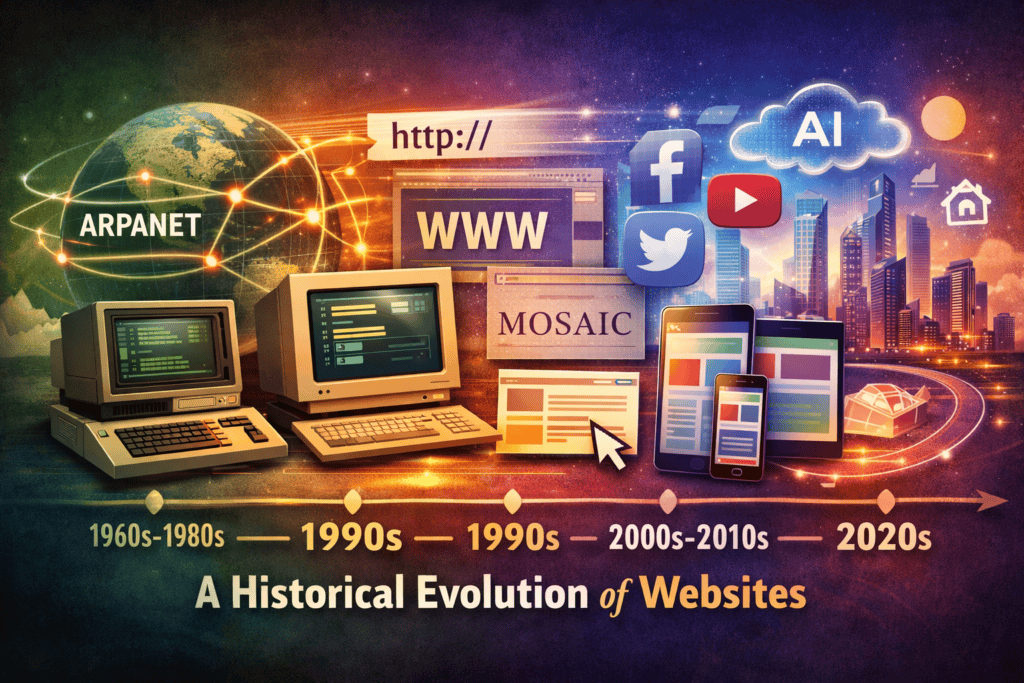
a historical evolution of websites

A Historical Evolution of Websites

Reading Time: 3 minutes
1960s–1980s: Laying the Groundwork

1960s – Pre-web internet: The U.S. Defense Department’s ARPANET connects the first computer networks, laying the foundation for global digital communication.

1989 – The Web concept is born: At CERN, Tim Berners-Lee proposes a universal hyperlinked information system, combining internet and hypertext ideas. This “World Wide Web” concept sets the stage for websites as we know them.

1990s: The World Wide Web Emerges

1990–1991 – Invention of the Web: Tim Berners-Lee develops the first web server and browser in 1990, then on August 6, 1991 he launches the world’s first website. That simple text page (hosted at info.cern.ch) explained the World Wide Web project and marked the public start of the Web era.

1993 – The Web goes public: CERN opens the Web’s technology to everyone, making it free to use. The same year, the Mosaic browser introduces inline images (pictures on webpages alongside text), a breakthrough that helped spark mainstream web adoption.

Mid-1990s – Explosion of websites: Once commercial use of the Internet is allowed in 1995, businesses and individuals rush online. Websites skyrocket from just 130 sites in 1993 to over 23,500 by 1995. Sites also become more interactive and visually rich – by the late ’90s many feature images, animated GIFs, and basic JavaScript for pop-up effects or scrolling text.

1996 – Web design comes of age: The introduction of Cascading Style Sheets (CSS) gives designers more control over page layout and styling, separate from HTML content. Along with new web standards, this makes sites more consistent across browsers and easier to maintain as they grow in complexity.

2000s: The Interactive Web and Social Media

2000 – Dot‑com bubble bursts: After a frenzy of growth in the late ’90s, the dot‑com bubble collapses in early 2000, causing many internet startups to fail. Yet the Web itself keeps growing and evolving through the downturn.

Early 2000s – Dynamic, data‑driven sites: Websites transition from static pages to interactive applications. New techniques (like AJAX) allow web pages to update seamlessly with fresh data. Server-side scripting and databases power richer features, and content management systems such as WordPress (2003) and Joomla (2005) let people build sites without coding, fueling a blogging boom.

Mid-2000s – Web 2.0 and social media: A more participatory Web emerges. “Web 2.0” sites encourage user-generated content and collaboration. Online social networks like Facebook (2004), YouTube (2005), and Twitter (2006) redefine how people connect and share information, making the Web a social platform.

2010s: Mobile-First Era

2010 – Responsive design: With smartphones on the rise, designers begin using “responsive” web design techniques (introduced in 2010) to ensure sites adapt to different screen sizes. Websites now need to work seamlessly on phones, tablets, and desktops.

2016 – Mobile surpasses desktop: In a major turning point, global web traffic from mobile devices overtakes desktop usage in 2016. This shift forces companies to prioritize mobile-friendly experiences, from simpler navigation to faster loading times for phone users.

2014–2018 – One billion websites: The Web’s growth hits a historic milestone. Around 2014, the number of websites surpasses one billion (though many are inactive or temporary). By the late 2010s, having a website is almost a necessity for businesses of all sizes, and the online economy—from e-commerce to digital media—is a dominant force in daily life.

2020s: Ubiquitous and Evolving

2020 – Pandemic pushes life online: The COVID‑20 pandemic accelerates digital transformation. With lockdowns in effect, organizations large and small rely on websites and web apps for remote work, e-commerce, education, and virtual events. Online traffic and online shopping surge as the world adapts to “everything from home.”

2025 – The Web’s immense scale: As of mid‑2025, there are approximately 1.12 billion websites in existence (though only ~17% are active). Around 73% of businesses globally have a website. Notably, the open-source platform WordPress powers about 43% of all websites on the internet, illustrating the dominance of easy-to-use content management systems.

2020s – Advanced web tech: Modern websites increasingly behave like full applications. Developers leverage powerful JavaScript frameworks and Progressive Web Apps to deliver fast, app-like experiences that can even work offline. Artificial intelligence is also emerging in web development, aiding in content creation and personalization to enhance user experiences.

Ongoing – Web woven into daily life: In just a few decades, the Web has grown from a handful of text pages into an indispensable part of modern life. Websites have fundamentally changed how we access information, shop, socialize, and more. As technology advances, the evolution of websites continues—always adapting to new devices, new demands, and new ways for people to connect.

A Historical Evolution of Websites Read More »

analytics the right way

Analytics the Right Way by Tim Wilson and Tom Sutherland Book Summary

Reading Time: 5 minutes

Top Three Quotes

  • “Getting data does not mean you get insight.”
    • This line punctures the assumption that collecting more data automatically creates value.
  • “Data are not valuable in and of themselves. You have to interact with the data in a particular way to get any insight from it.”
    • The core thesis of the book: value comes from how you use data, not from its volume.
  • “A KPI without a target is just a metric.”
    • A sharp reminder that measurement must be tied to expectations and decisions, not dashboards.

Book Theme

The central theme of Analytics the Right Way is that organizations only get value from data when they use it deliberately to support decision-making and operations—through three distinct but connected uses of data: performance measurement, hypothesis validation, and operational enablement.

Why You Should Read This Book

  • If you feel “data rich but insight poor,” this book explains why that happens and gives you a concrete way out.
  • It translates rigorous causal thinking and statistical reasoning into practical language for executives, managers, and product leaders.
  • It offers a simple, memorable framework you can use to align analytics teams, business stakeholders, and technology investments around real business value instead of “big table mentality.”
  • It is grounded in real client stories and vignettes that mirror the messy situations leaders actually face.

Key Ideas and Arguments Presented

  1. More data is not the same as more insight.
    • The shift from “data desert” to “data deluge” created a belief that data itself is valuable, like oil, when in reality it is worthless without refinement and theory.
  2. Four common misconceptions about data distort how organizations invest.
    • The book challenges four beliefs: that enough data can eliminate uncertainty, that data must be comprehensive to be useful, that data are inherently objective, and that democratizing access automatically makes an organization data-driven.
  3. Decision-making is about minimizing regret under uncertainty, not finding certainty.
    • Good decisions systematically reduce regret given inevitable uncertainty, rather than pretending uncertainty can be removed.
  4. The “potential outcomes” framework clarifies causality.
    • Potential outcomes and counterfactuals help leaders think clearly about what would have happened under different choices, grounding causal claims in a simple mental model.
  5. There are three fundamentally different ways to use data.
    • Performance measurement, hypothesis validation, and operational enablement are distinct business activities that must be approached differently.
  6. Performance measurement should be driven by “two magic questions.”
    • Start with “What are we trying to achieve?” and “How will we know if we’ve done that?” before defining KPIs, targets, and dashboards.
  7. Hypotheses must be explicit, actionable, and managed as a portfolio.
    • The book uses a simple “Idea, Theory, Action” template and a hypothesis library to turn scattered ideas into an organized pipeline of tests.
  8. Not all evidence is equal: the ladder of anecdotal, descriptive, and scientific evidence.
    • Leaders should match the evidence-gathering method to the cost and importance of the decision, rather than defaulting to dashboards or experiments.
  9. Descriptive and scientific analyses have predictable pitfalls.
    • Unit of analysis errors, omitted variables, time effects, selection bias, and confounding can all mislead decisions if not handled carefully.
  10. Operational enablement turns validated hypotheses into scalable business logic and automation.
    • Trade secrets and mechanisms discovered through hypothesis validation can be encoded into rules, models, and AI systems with appropriate human oversight.

Book Outline

  • Chapter 1: Is This Book Right for You?
    • The Digital Age = The Data Age
    • What You Will Learn in This Book
    • Will This Book Deliver Value?
  • Chapter 2: How We Got Here
    • Why common misconceptions about data hurt our ability to draw insights.
    • Exploration of four major misconceptions, including the “data is the new oil” analogy.
  • Chapter 3: Making Decisions with Data – Causality and Uncertainty
    • Decision-making under uncertainty, minimizing regret, and introducing the potential outcomes framework.
  • Chapter 4: A Structured Approach to Using Data
  • Chapter 5: Making Decisions Through Performance Measurement
    • Why “What are your KPIs?” is the wrong starting question.
    • The two magic questions and methods for setting targets and using dashboards effectively.
  • Chapter 6: Making Decisions Through Hypothesis Validation
    • Framework for articulating, prioritizing, and tracking hypotheses in a hypothesis library.
  • Chapter 7: Hypothesis Validation with New Evidence
    • Introduction to the ladder of evidence: anecdotal, descriptive, and scientific.
  • Chapter 8: Descriptive Evidence – Pitfalls and Solutions
    • How to avoid common mistakes in historical and descriptive analysis.
  • Chapter 9: Pitfalls and Solutions for Scientific Evidence
    • Selection bias, confounding, and the essentials of controlled experimentation.
  • Chapter 10: Operational Enablement Using Data
    • The factory metaphor, trade secrets, automation costs, and the role of machine learning and AI.
  • Chapter 11: Bringing It All Together
    • How the three uses of data interconnect, plus guidance on communication, technology, and decision-making.

Key Takeaways

  • Collecting more data does not solve business problems; refining data with clear theory and purpose does.
  • Leaders should treat uncertainty as inevitable and focus on minimizing regret, not chasing impossible certainty.
  • Every use of data should clearly fall into one of three categories: performance measurement, hypothesis validation, or operational enablement.
  • Performance measurement must start from clearly stated goals and targets; otherwise, dashboards become expensive wallpaper.
  • Actionable insight requires explicit hypotheses, documented as a portfolio, with methods and levels of evidence appropriate to the stakes.
  • Descriptive and scientific analyses are powerful but fragile; careless design and bias can systematically mislead decisions.
  • Operational enablement is where analytics scales—turning tested mechanisms into rules and models embedded in processes and products.
  • The greatest value arises when all three uses of data operate in unison, like sections of an orchestra working from the same score.

Key Techniques

  • The Two Magic Questions (Performance Measurement)
    • 1) What are we trying to achieve? 2) How will we know if we’ve done that?
  • KPI Design with Explicit Targets
    • KPIs only become meaningful when paired with target values and timelines.
  • Hypothesis Formulation Template (Idea – Theory – Action)
    • “We believe [Idea] … because [Theory] … If we are right, we will [Action].”
  • Hypothesis Library and Life Cycle Management
    • Document, prioritize, and track hypotheses from ideation through validation and archival.
  • Evidence Ladder and Method Selection
    • Choose between anecdotal, descriptive, and scientific evidence based on decision cost and importance.
  • Bias and Pitfall Checklists
    • Use simple checks and causal diagrams to guard against unit-of-analysis errors, omitted variables, and selection and confounding bias.
  • Operational Enablement Factory Model
    • View data-driven operations as a factory with defined inputs, mechanisms, outputs, and levels of automation and human oversight.

Author’s Qualifications

  • Tim Wilson
    • Veteran analytics practitioner who built and led analytics practices at multiple agencies, consulted with Fortune 500 firms, co-founded the consultancy facts & feelings, and co-hosts the Analytics Power Hour podcast.
    • Holds a BS from MIT and an MBA from the University of Texas at Austin.
  • Dr. Joe Sutherland
    • Director of the Emory Center for AI Learning and principal investigator in the US AI Safety Institute Consortium.
    • Former executive at Amazon and Cisco, founder of two AI/fintech startups, and published researcher in machine learning and AI.
    • Holds a PhD, MPhil, and MA from Columbia University.

Comparison to Similar Books

  • Analytics the Right Way is less about algorithms than Data Science for Business and more about how leaders should structure decisions and analytics work.
  • Compared with books like Naked Statistics or The Signal and the Noise, it focuses on operational frameworks rather than statistical intuition alone.
  • Relative to Analytics at Work or Competing on Analytics, it dives deeper into causal reasoning, experimentation, and the distinction between measurement, testing, and operationalization.
  • Versus typical “AI for business” titles, it is more skeptical of hype and more explicit about costs, governance, and when simple approaches beat complex models.

Target Audience

  • Senior business leaders and executives who sponsor analytics, AI, or data initiatives.
  • Marketing, product, and digital leaders overwhelmed by dashboards but underwhelmed by insight.
  • Analytics, data science, and BI leaders seeking a shared language with business stakeholders.
  • Operations and customer-experience leaders embedding data into processes and automation.
  • Strategy and innovation teams building AI-first or data-first offerings.
  • Consultants and agency partners looking for a clearer playbook for delivering value, not just reporting.
  • Non-technical managers who want to become better consumers of analytics and experimentation.

Critical Response to the Book

Analytics the Right Way is a very recent book, so broad external critical reception is still emerging, but it reflects the authors’ well-established perspectives in the analytics and AI community and even “measures” its own impact by asking readers to rate each chapter against clear performance goals.

One Sentence Takeaway

Real business value from data comes not from hoarding it, but from using a clear framework to measure performance, validate hypotheses, and embed proven mechanisms into operations so leaders can make better decisions under uncertainty.

Analytics the Right Way by Tim Wilson and Tom Sutherland Book Summary Read More »

case study bmw seo penalty

Case Study: BMW’s SEO Shortcut That Led to a Google Ban

Reading Time: 7 minutes

Brief Summary

In 2006, BMW’s German website attempted a search engine optimization shortcut that backfired spectacularly.

The automaker used hidden “doorway” pages stuffed with keywords to boost its Google rankings for terms like “used car,” only to be caught and banned from Google’s index.

This short-lived scheme caused public embarrassment for BMW, as Google’s crackdown made headlines worldwide. The incident serves as a cautionary tale about the risks of black-hat SEO tactics and the importance of ethical marketing practices.

Company Involved

The company at the center is BMW, the luxury automobile manufacturer. The case specifically involves BMW’s German website (BMW.de), which was a flagship online presence for the brand in Europe. BMW is known for its innovation in both cars and marketing, which makes this misstep particularly instructive.

Marketing Topic

Search Engine Optimization (SEO) – Specifically, the ethics of SEO and the consequences of “black hat” techniques (like cloaking and doorway pages) that violate search engine guidelines.

Public Reaction or Consequences

News of Google banning BMW.de exploded in the media, receiving “unprecedented coverage by mainstream publications” for a search engine penalty. Tech outlets and major newspapers alike reported on Google’s move, highlighting that no company, not even a top global brand, is above Google’s rules. BMW quickly removed the deceptive pages and publicly claimed it hadn’t meant to manipulate search results, stating it only wanted to “offer a better service” to used-car shoppers. Nonetheless, the public perception was that BMW had been “caught cheating” the system, leading to short-term reputational damage. Google’s swift and high-profile action also put other companies on alert – notably, Ricoh’s German site was penalized the same way, proving this was part of a broader clampdown.

The immediate consequence for BMW was that BMW.de disappeared from Google search results, even for queries for “BMW” itself. The site’s Google “PageRank” was manually dropped to zero, effectively wiping out its search visibility. This could have meant significant loss of web traffic. However, the ban was temporary. Within days, BMW complied with Google’s guidelines, and the site was allowed back in Google’s index after submitting a re-inclusion request and demonstrating the offending pages were fixed. The incident did, however, live on in public memory and SEO lore as a high-profile example of what not to do.

Why It Matters Today

  • Ethics in SEO: This case underscores that search engines will enforce ethical behavior. Tricks to manipulate rankings might yield short-term gains but carry high long-term risks.
  • No Brand Is Immune: Google’s penalty on BMW proves that even huge brands can’t flout the rules. In today’s era of AI-driven algorithms and strict quality guidelines, all marketers must play by the rules or face serious consequences.
  • Trust and Transparency: Marketing strategies must prioritize user experience and transparency. Deceptive tactics not only risk penalties but also erode public trust if exposed. In an age of instant news and social media, such missteps become very public lessons.

3 Takeaways

  1. Follow the Rules: Always adhere to search engine guidelines. Shortcuts like cloaking or keyword-stuffed doorway pages will eventually be discovered and punished, nullifying any initial benefit.
  2. Reputation is Fragile: Marketing tactics that deceive users (or regulators) can seriously damage a brand’s reputation. In the digital age, news of misbehavior travels fast, so ethical marketing is not optional.
  3. Oversight is Key: If you outsource SEO or digital marketing, ensure the agencies or teams you work with use white-hat practices. BMW’s fiasco suggests the possibility that an overzealous marketer or third-party SEO firm employed risky tactics – but ultimately the brand itself bears the fallout.

Notable Quotes and Data

  • “Don’t deceive your users or present different content to search engines than you display to users” – Google’s core guideline, which BMW violated.
  • “If the Google Guidelines were the 10 Commandments, the rule that BMW broke would be comparable to the ‘Thou Shalt Not Kill’ rule.” – Loren Baker, editor of Search Engine Journal, emphasizing the gravity of BMW’s offense.
  • The German word for “used car” (Gebrauchtwagen) appeared 42 times on one BMW doorway page – a blatant example of keyword-stuffing designed for search bots.

Full Case Narrative

In early 2006, BMW’s German division launched an aggressive SEO technique aimed at dominating search rankings for car-related queries. At the time, being at the top of Google for terms like “used cars” was incredibly valuable for attracting customers. BMW.de implemented so-called doorway pages – web pages crammed with keywords and optimized purely for search engines, not for human users. These pages would immediately redirect visitors to BMW’s more polished main site. In BMW’s case, a doorway page would show Google’s crawler a text-heavy page (for example, containing the word “used car” dozens of times), but actual users were seamlessly sent to a different page with images and normal content. This tactic is a form of cloaking, showing different content to the search engine than to the user.

Google’s Webspam team, led by engineer Matt Cutts, discovered BMW’s scheme in late January 2006. On February 4, 2006, Cutts announced on his blog that Google had removed BMW.de from its index for violating guidelines. He explained that BMW’s pages were using JavaScript redirects to feed bogus keyword-laden pages to Google’s crawler. As soon as this news broke, it set off alarms in the SEO community and beyond. While smaller websites getting banned was not uncommon, seeing a major global brand like BMW get the so-called “Google death penalty” was unprecedented.

Google’s action was swift and uncompromising. By February 6, 2006, BMW.de was officially delisted, meaning it would not appear in Google search results at all. Even if someone searched for “BMW,” the German site would be absent. Google even confirmed that BMW’s punishment was a direct result of breaching its Webmaster Guidelines, specifically the rule against deceiving users and search engines. At the same time, Google also penalized Ricoh’s German website for a similar offense, signalling a broader campaign against webspam in international markets.

The mainstream media picked up the story quickly. Outlets like the BBC, Forbes, and The New York Times ran pieces on Google’s ban of BMW. This wide coverage was remarkable for a tech issue like SEO, and it showed that digital marketing missteps could become global news. Many reports noted how embarrassing this was for BMW – a brand that prides itself on excellence – to be called out for “search engine spamming.” Observers also saw Google’s very public penalty as a message: Google would not hesitate to enforce its rules, even against powerhouse companies.

BMW’s initial response was a mix of damage control and subtle defiance. A BMW spokesperson, Markus Sagemann, admitted to the BBC that the company had used doorway pages on BMW.de. However, he argued that the content on those pages was essentially the same as what users saw on the site, implying that BMW didn’t intend to mislead anyone. “If Google says all doorway pages are illegal we have to take this into consideration,” he conceded. In other words, BMW claimed it hadn’t meant to “cheat,” but would comply with Google’s demands. This statement hinted at a misunderstanding (or miscalculation) on BMW’s part – perhaps they thought that as long as the final page content was legitimate, the doorway technique would be overlooked or was acceptable. Google obviously disagreed.

Behind the scenes, BMW moved quickly to fix the issue. They removed the doorway pages and any hidden text once they were made aware of the penalty. BMW then submitted a re-inclusion request to Google, essentially an apology and plea for reinstatement, explaining what they had done to correct the site. Google’s Matt Cutts had indicated this would be necessary, and even asked BMW to disclose who built the spammy pages as part of the conditions for forgiveness. This detail suggests Google was interested in whether an outside SEO agency was involved.

After a brief period (just a few days), Google lifted the ban on BMW.de. By mid-February 2006, the site was back in Google’s search results, and its PageRank was restored. In its public statements, BMW maintained that it did not intentionally deceive Google’s system. The swift reinstatement indicated that Google was satisfied with BMW’s cleanup and perhaps appreciated the brand’s relatively prompt cooperation. However, the lesson had been delivered to BMW and everyone else watching: manipulative SEO tactics can lead to very public consequences.

SEO experts and marketers around the world reacted to the BMW incident with a mixture of schadenfreude and concern. Some pointed out that it was “surprising that the ruse lasted as long as it did” given how obvious the spam was. Loren Baker of Search Engine Journal famously quipped about the severity of BMW’s violation (comparing it to a cardinal sin) and questioned whether the blame lay with BMW’s management or an unethical hired SEO firm. The consensus in the industry was that this high-profile penalty would usher in greater scrutiny of SEO practices. In fact, Google’s willingness to ban BMW signaled to other companies that no one gets a free pass on violating guidelines, no matter how big their advertising spend or brand recognition.

Timeline (Optional)

  • Late January 2006: Google’s engineers detect doorway pages on BMW.de, indicating search spam practices.
  • February 4, 2006: Google’s Matt Cutts announces on his blog that BMW’s German site will be removed from Google’s index for violating guidelines.
  • February 6, 2006: BMW.de is officially delisted from Google search results, and news of the ban is reported by major media outlets.
  • February 7, 2006: BMW spokespeople express confidence that the site will be restored soon and insist they didn’t intend to game the system.
  • Mid-February 2006: After removing the doorway pages and complying with Google’s requirements, BMW.de is reinstated in Google’s index, ending the penalty period.

What Happened Next?

Following the incident, BMW took steps to ensure such an SEO embarrassment would not recur. The company likely reviewed its digital marketing strategies and the activities of any external search consultants. In the years after 2006, BMW continued to invest heavily in legitimate online marketing and content. The brand has not had any similar run-ins with Google since, indicating that BMW learned its lesson about staying within guidelines.

The broader impact of the BMW case was felt across the industry. Marketers became warier of overly aggressive SEO tactics, especially cloaking and doorway pages. Google, for its part, continued to refine its algorithms and penalty systems to catch spam. The BMW ban became a reference point in SEO conferences and articles – a perfect example of how even a top-tier brand can face consequences for “black hat” behavior. Today, BMW’s marketing focuses on innovation and user engagement (for example, interactive campaigns and social media), rather than trying to trick search engines. The company’s digital presence is strong, and BMW.de ranks well in Google – this time on the strength of genuine content and SEO best practices, not cheats.

One Sentence Takeaway

Even global brands must play by the rules: BMW’s experience shows that attempting to deceive search engines can lead to public humiliation and a hard lesson in the importance of ethical marketing.

Sources and Citations

E-Commerce Times – “Google Says BMW Manipulated Search Rankings” (Feb 6, 2006)

Search Engine Journal – “Google Bans BMW for Search Spamming” (Feb 6, 2006)

Out-Law News – “Google removes BMW.de over optimisation tactic” (Feb 7, 2006)

Wikinews – “Google removes German BMW from search results” (Feb 6, 2006)

Case Study: BMW’s SEO Shortcut That Led to a Google Ban Read More »

common integrated marketing mistakes

The 10 Most Common Integrated Marketing Mistakes (and How to Fix Them)

Reading Time: 6 minutes

Integrated marketing looks great on slides. Channels line up. Arrows point neatly from left to right. But in practice, a lot of integrated marketing efforts stall, fragment, or underperform.

Let’s look at 10 common mistakes that quietly break integrated marketing systems and offer practical ways to fix each one. The goal is not perfection. The goal is to help your channels, content, data, and systems actually work together instead of pulling in different directions.

1. Treating Integrated Marketing as Campaign Coordination Instead of System Design

Many teams still treat integrated marketing as a way to coordinate messages across a campaign. They match headlines, share creative assets, and review launch calendars. All of that is useful, but it is not enough.

When integrated marketing stops at campaign coordination, the underlying system remains fragmented. Channels fight for credit, data lives in different tools, and customers experience a series of disconnected moments.

How to fix it:

  • Think in terms of architecture, orchestration, and optimization, not just campaigns.
  • Map how traffic, data, and experiences move across your web properties and tools.
  • Ask how each decision affects the whole marketing engine, not just a single campaign.

2. Running Teams in Silos

Silos are one of the biggest reasons integrated marketing fails. Channel teams are measured separately, sit in different tools, and report to different leaders. It is no surprise that the work ends up fragmented.

Siloed teams today can create even more fragmentation than IMC era teams did because each team now owns a different part of the digital experience. Customers feel that fragmentation as friction and confusion.

How to fix it:

  • Create shared outcomes that cut across teams, such as full journey conversion or revenue influence.
  • Design reporting at the system level and use shared dashboards so every team is working from the same journeys, metrics, and outcomes. Shared reporting prevents channel teams from drifting back into siloed goals.
  • Hold regular cross functional reviews that focus on journeys and systems, not just channel performance.
  • Encourage channel owners to bring problems and ideas that affect the whole ecosystem, not only their local metrics.

3. Letting Every Channel Try to Do Everything

When every channel tries to drive awareness, consideration, and conversion on its own, the result is a noisy and inefficient system. Channels overlap in some places and leave gaps in others. Customers encounter repeated messages and dead ends.

Without clear roles, no one knows which channels are responsible for what part of the journey. That makes it hard to prioritize, measure, or improve the system.

How to fix it:

  • Assign a clear primary role to each channel, such as demand capture, demand creation, nurture, or retention.
  • Document those roles and share them widely so teams understand how their work fits into the bigger picture.
  • Review channel roles at least once a year so they evolve with your strategy and customer behavior.

4. Building Content Without a Content Architecture

Many organizations publish content reactively. Sales needs a one pager, product needs a feature blog, social needs a quick post, and so on. Over time this creates a pile of disconnected content that is hard to maintain and even harder to reuse.

Without a content architecture, it is difficult to support multiple channels, journeys, and segments with the same core ideas. The result is inconsistent messaging and wasted effort.

How to fix it:

  • Define content pillars that align to your strategy and key problems you solve.
  • Create pillar web pages and supporting cluster web pages that can serve search, paid, email, and sales at the same time.
  • Design content to be modular so pieces can be reused across different formats and channels.

5. Mapping Journeys but Not Fixing the Weak Links

Journey maps often look impressive, but they do not always change how the work happens. Teams map dozens of touchpoints, print a diagram, and then continue operating exactly as before.

The real value of journey mapping is in finding and improving the weak links where people drop off, get confused, or hit a dead end. Without that focus, journey mapping becomes a static exercise rather than a driver of integrated marketing.

How to fix it:

  • Start with two or three high value journeys instead of trying to map everything.
  • Identify the most common starting points and key moments of truth for each journey.
  • Choose one weak link at a time to improve, such as a broken handoff between an ad and a landing web page or between a form fill and a follow up email.

6. Optimizing Channels Instead of Connections

It is tempting to chase siloed wins. Better subject lines. Cheaper clicks. Higher rankings. Those things matter, but they can distract from the bigger opportunity, which is improving how channels work together.

When teams only optimize inside their own channel, they miss the compounding effect that comes from smoother flows across channels. A higher click through rate is nice. A better end-to-end journey is usually worth much more.

How to fix it:

  • Include at least one cross channel experiment in every testing cycle.
  • Look at assisted conversions and multi step flows, not just single touch performance.
  • Ask whether a change improves the entire path from first touch to value, not just a single metric.

7. Missing or Broken Measurement

Integrated marketing depends on integrated measurement. When tracking is incomplete or inconsistent, teams have to fall back on guesswork and channel level reports. That undermines confidence in the system and makes it difficult to justify changes.

Common issues include inconsistent UTM tagging, missing event tracking, and reports that only show last click attribution. These gaps hide how channels support one another.

How to fix it:

  • Agree on a simple but consistent naming convention for UTMs and campaign identifiers.
  • Ensure key events are tracked across your web properties, app, and product where possible.
  • Start from shared system level outcomes and work backward to define what each channel needs to track.
  • Add basic multi touch views, such as assisted conversions and simple journey reports, even if you are not ready for full attribution modeling.
  • Make dashboards shared and system level so teams see the same journeys, metrics, and results instead of separate reports for each channel.

8. Misaligned Martech That Adds Friction Instead of Flow

It is easy to add tools to the stack and much harder to make them work together. Over time, many organizations end up with overlapping tools, disconnected data, and manual workarounds that increase friction.

When the martech stack is not aligned with the integrated marketing strategy, teams spend more time wrestling systems than improving journeys. Data gets trapped, errors creep in, and customers feel the impact.

How to fix it:

  • Map your core systems and define what each one is responsible for.
  • Identify where data needs to move automatically between systems to support your key journeys.
  • Remove or consolidate tools that duplicate functionality or create unnecessary complexity.

9. Over Relying on Launches Instead of Always On Systems

Campaigns and launches will always be part of marketing, but many teams still behave as if launches are the main way results happen. They sprint toward a release, work late to get assets out the door, then lose momentum until the next big push.

Integrated marketing depends on always on systems that keep capturing, nurturing, and converting demand between launches. Without those systems, each campaign has to work much harder than it should.

How to fix it:

  • Separate your planning into always on programs and time bound campaigns.
  • Ensure that each campaign strengthens or reuses parts of your always on system instead of starting from scratch.
  • Invest in evergreen assets and flows that continue to perform long after a campaign ends.

10. Having No Operating Model to Run the System

Even a well designed integrated marketing system will struggle if there is no clear way to run it. Without shared rituals, workflows, and decision rules, teams default back to ad hoc requests and reactive work.

An operating model defines how planning happens, how work moves, how decisions are made, and how learning is shared. It turns integrated marketing from an idea into a repeatable practice.

How to fix it:

  • Establish regular rhythms such as weekly standups, monthly performance reviews, and quarterly planning sessions focused on the system, not just channels.
  • Document key workflows for creating briefs, prioritizing work, and routing approvals.
  • Agree on who owns the integrated marketing architecture and how changes to it are proposed and approved.

Bringing It All Together

Most integrated marketing failures are not caused by a lack of ideas or effort. They come from treating integration as a campaign task instead of a system to design, run, and improve.

By avoiding these common mistakes and focusing on the connections between channels, content, data, and systems, you can build a marketing engine that works more like a single, coherent experience and less like a collection of disconnected activities.

The goal is not to eliminate every silo or fix every weak link at once. The goal is to make steady progress toward a system where each improvement helps the whole engine run smoother.

The 10 Most Common Integrated Marketing Mistakes (and How to Fix Them) Read More »

integrated marketing imc key question

How Integrated Marketing Has Evolved Beyond IMC: A Practical Comparison for Modern Marketers

Reading Time: 3 minutes

Most marketers are familiar with integrated marketing communications, or IMC.

For years it was the dominant lens for understanding how to coordinate campaigns, align messages, and keep creative consistent across channels. IMC still has value, but it does not fully match the complexity of how marketing works today.

Let’s compare IMC with modern integrated marketing so you can see exactly where the models overlap, where they diverge, and why the shift matters.

It is designed to clarify the terminology, not replace the history or minimize the usefulness of IMC. The goal is simply to make the differences clear in a way that helps teams operate more effectively.

The Short Answer

IMC focuses on coordinating communications. Modern integrated marketing focuses on designing the entire marketing system so channels, content, data, and technology work together.

IMC asks whether everything matches. Integrated marketing asks whether everything works together.

What IMC Originally Meant

Integrated marketing communications emerged in the 1990s as organizations tried to unify their advertising, PR, promotions, and sales messaging. The goal was simple and useful: create a consistent brand story across all communications.

In practice, IMC focused on:

  • Coordinating campaign messages
  • Aligning creative assets
  • Maintaining brand voice across channels
  • Supporting product launches with unified communications
  • Ensuring consistency between advertising and sales materials

IMC worked well for its time. Channels were fewer, journeys were more predictable, and communications were the primary lever marketers controlled.

What IMC Still Does Well

Even today, IMC still matters. It is still useful for:

  • Maintaining message discipline
  • Coordinating creative across a campaign
  • Ensuring brand consistency
  • Supporting product marketing and launch planning
  • Creating unified customer facing materials

IMC is not outdated. It is simply incomplete for the realities of digital, cross channel, and system level marketing.

The Limits of IMC in a Digital Environment

Modern journeys do not behave like funnels. As Rand Fishkin has described, they look more like a pinball machine, with people bouncing unpredictably across search, social, referrals, ads, emails, and product experiences. IMC was built for linear paths, not pinball shaped ones, and digital marketing changed more than the number of channels. It changed how people move, how data flows, how systems connect, and how teams operate. IMC was never designed to handle:

  • Nonlinear customer journeys
  • Search behavior and demand capture
  • Always on content ecosystems
  • Lifecycle programs and retention loops
  • Marketing automation, CRM, and CDP driven experiences
  • Analytics and assisted conversion patterns
  • Cross channel performance dependencies
  • Technical integrations across systems

This is why modern integrated marketing needs a broader lens.

How Integrated Marketing Has Evolved Beyond IMC

Modern integrated marketing includes communications, but it is not limited to them. It incorporates channels, systems, content, data, technology, and the full customer experience. It also treats the marketing ecosystem as a connected engine rather than a collection of campaigns.

Integrated marketing in a modern context includes:

  • Channel roles and cross channel alignment
  • Content architecture and modular content reuse
  • Data capture and attribution
  • Journey mapping beyond campaigns
  • Marketing operations and system design
  • Lifecycle flows and retention programs
  • Martech stack integration
  • Cross functional collaboration and governance

It is a broader, deeper, more operationally grounded discipline.

IMC vs Modern Integrated Marketing

This table summarizes the core differences between the two models.

DimensionIMCModern Integrated Marketing
Core PurposeMessage consistencySystem level performance
Primary FocusCampaigns and communicationsChannels, content, data, and systems
Key QuestionDoes everything match?Does everything work together?
ScopeBrand and communicationsFull marketing ecosystem
MeasurementChannel level metricsCross channel and journey analytics
Tools and TechnologySupport roleCentral to execution and data flow
Team InvolvementBrand, comms, and product marketingBrand and comms plus operations, analytics, product, and revenue teams
OutputAligned messages and creativeAligned channels, journeys, and experiences
Success DefinitionConsistencyCohesion and performance

Where IMC Still Matters

IMC remains valuable for:

  • Launch planning
  • Creative alignment
  • Brand consistency
  • Campaign level coordination

Modern integrated marketing builds on IMC rather than replacing it.

Where IMC Falls Short Today

IMC is not designed for:

  • System design
  • Data integration
  • Cross channel measurement
  • Marketing automation and lifecycle flows
  • Operational alignment across teams
  • Always on ecosystem management

This is the gap modern integrated marketing fills.

Why This Comparison Matters

Many teams still use IMC language to describe work that has grown far beyond the scope of communications. When the terminology is unclear, expectations become unclear. This comparison helps reframe the conversation so teams can align on what integrated marketing means today and what it requires.

How This Fits Into the Broader Framework

If IMC describes the coordination of communications, modern integrated marketing describes the design and ongoing improvement of the entire marketing engine. For a deeper explanation of that approach, see the Modern Integrated Marketing Framework.

Together, these perspectives help marketers understand the past, clarify the present, and operate in a way that meets the needs of today’s digital environment.

How Integrated Marketing Has Evolved Beyond IMC: A Practical Comparison for Modern Marketers Read More »