integrated marketing framework

The Modern Integrated Marketing Framework: Systems, Channels, Content, and Data

Reading Time: 5 minutes

Most teams have strategies. Many have channels. Some have journeys. Few have a system that makes all of those things work together. That is the gap this framework aims to close.

Integrated marketing today is less about pretty alignment and more about system design. This web page outlines a practical, usable structure to help marketers connect channels, content, data, and technology into one functioning engine.

This framework is not academic. It brings together widely recognized practices from marketing strategy, IMC, growth, and operations into a structure that reflects how modern teams actually work.
Modern Integrated Marketing Framework

The Problem This Framework Solves

Marketers are surrounded by pieces.

Channels. Tools. Data. Teams. Campaigns.

But none of these pieces perform well in isolation.

Common symptoms of under integrated systems include:

  • Paid media that drives traffic but not revenue
  • SEO content that ranks but does not support conversion
  • Social content that builds awareness but sends people into dead ends
  • Lifecycle flows that do not align with the product experience
  • Martech stacks with overlapping or misconfigured tools
  • Data that exists but does not inform decisions

This framework is meant to solve the problem of pieces moving without purpose.

The Integrated Marketing Framework

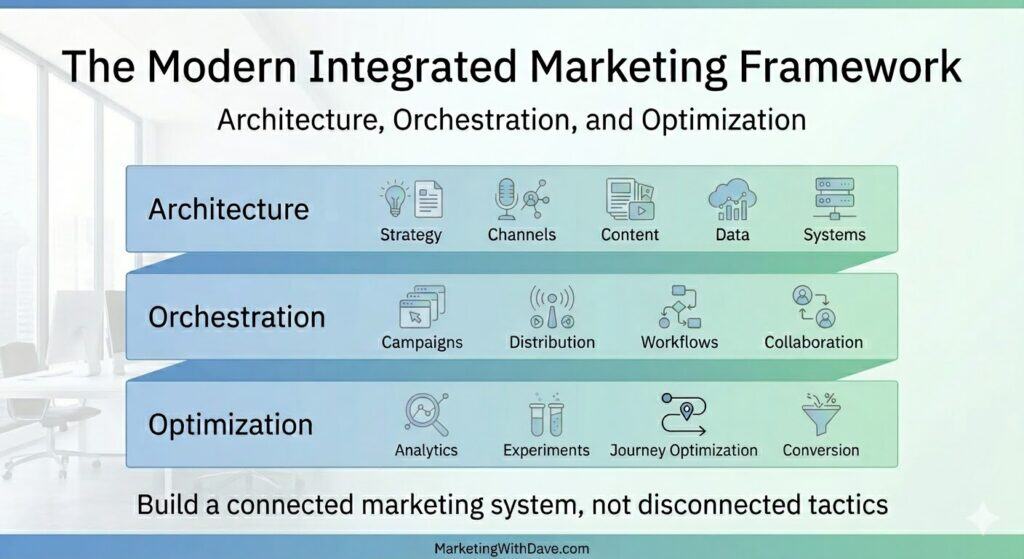
Your modern integrated marketing engine is built on three layers.

Architecture, orchestration, and optimization.

Layer 1: Architecture

Architecture is the foundational design. It is the blueprint.

Architecture answers the question:

What is the role of every channel, tool, and content asset, and how do they connect?

Key architectural elements include:

  • Strategy and audience definition
  • Channel roles, such as demand capture, demand creation, retention, community, and conversion
  • Core customer journeys
  • Content pillars that support multiple channels and stages
  • Data capture and tagging
  • Martech systems such as CMS, CRM, CDP, marketing automation, analytics, and ad platforms
  • Measurement structure and key outcomes

Architecture turns marketing from a collection of efforts into an intentional system.

Layer 2: Orchestration

Orchestration is the day-to-day execution inside the architecture.

Orchestration answers the question:

How does work move through the system?

Orchestration includes:

  • Campaign planning across channels
  • Always on programs that run alongside campaigns
  • Distribution models for content and creative
  • Publishing cadences and calendars
  • Cross channel reinforcement so messages and offers support each other
  • Workflow and routing of requests, briefs, and approvals
  • Asset reuse and translation for different channels
  • Collaboration between SEO, paid, lifecycle, social, and operations teams
  • Governance, such as who owns what decisions and how exceptions are handled

Orchestration is where strategy meets reality.

Layer 3: Optimization

Optimization is the ongoing improvement of the system.

Optimization answers the question:

What is the next high value connection to improve?

Optimization activities include:

  • Journey analytics that show how people really move through the ecosystem
  • Views that include assisted conversions, not only last click
  • Experiments that test changes across a full flow, not just a single ad or web page
  • Channel-to-channel collaboration to reduce overlap and gaps
  • Simplifying or consolidating technology where it adds friction
  • Turning rough handoffs into smoother transitions between touchpoints
  • Reducing friction and drop offs at known weak points in the journey

Optimization is where small improvements unlock compounding returns.

The Roles of Channels Inside the Framework

One of the biggest failures in marketing is that every channel tries to do everything.

Integrated marketing works when channel roles are defined and respected.

An example model for channel roles might look like this:

  • SEO captures existing demand and educates people who are already searching
  • Paid media accelerates awareness and tests new messages and audiences
  • Social builds connection, community, and lightweight engagement
  • Content marketing supports every channel and builds trust by answering real questions
  • The website converts interest into actions such as signups, trials, or sales
  • Email and lifecycle programs nurture, retain, and grow customer value over time
  • Surveys and voice of customer programs tighten the feedback loops
  • Martech and operations automate delivery and unify data
  • Analytics clarifies what works, what does not, and where to focus next

This kind of model becomes the shared mental map that the team operates from.

How Channels Reinforce Each Other

Integration lives in the connections between channels, not inside the channels themselves.

Some of the highest leverage integration points inside any marketing system include:

  • Search to website
  • Paid media to landing pages
  • Social to content
  • Content to lifecycle
  • Lifecycle to product experience
  • Product experience to retention and expansion loops
  • Surveys and feedback to optimization and testing

When any of these links fail, the whole engine loses power.

When you fix even one of them, the engine runs smoother.

Journey Mapping for Integrated Marketing

Most journey maps are designed for slides, not for decisions.

For integrated marketing, the goal is to map enough of the journey to improve it, without trying to model every possible path.

A practical approach looks like this:

  • Define the two or three core journeys that matter most for the business
  • Identify starting points such as search, referrals, social, ads, and direct visits
  • Identify the key moments of truth such as web pages, emails, product touchpoints, and sales conversations
  • Identify typical drop offs and dead ends
  • Strengthen the weakest link in each priority journey

The goal is not to map everything.

The goal is to map what matters and improve what is broken.

Content Architecture as the Glue

A modern marketing engine depends on a content structure that supports multiple teams and channels at once.

A strong content architecture often includes:

  • Pillar web pages that explain key topics in depth
  • Cluster web pages that support those pillars and explore subtopics
  • Evergreen assets that multiple channels can point to over time
  • Modular content that can be reused in different formats and channels
  • Content mapped to journey stages and channel roles
  • Web pages built for both organic search and conversion paths

Content is the connective tissue of the entire system.

The Data and Measurement Layer

Integrated marketing requires integrated measurement.

Without a shared view of performance, teams fall back into channel silos and siloed metrics.

Essential elements of the data and measurement layer include:

  • Event tracking aligned to the journeys you actually care about
  • Cross channel attribution, even if it starts simple
  • Dashboards that show assisted conversions, not just single touch performance
  • Source and medium discipline so traffic and outcomes can be trusted
  • Measurement tied to clear roles and business outcomes
  • Regular reviews that look at system level performance, not just isolated channels

When measurement aligns with the integrated system, the team moves faster and makes better decisions.

A One Page Integrated Marketing Blueprint

To keep this framework practical, it helps to capture it on a single page that the team can reference.

A one page blueprint might summarize:

  • Your strategy and audiences
  • Channel roles across the ecosystem
  • The most important journeys to support
  • Key content pillars and cornerstone assets
  • Your data and tagging plan
  • The main systems in your stack and how they connect
  • The top connections or weak links you plan to improve next

This kind of blueprint becomes a living document that anchors conversations and decisions.

How to Put the Framework to Work

A framework only matters if it changes how you operate.

One simple way to put this model into practice is to work through five steps:

  • Define your architecture by listing channels, systems, and key journeys
  • Assign clear roles to each channel so they are not all trying to do everything
  • Map the most important journeys that connect channels and product experience
  • Create or reorganize content so it supports those journeys and roles
  • Install measurement and optimization habits that focus on connections, not just channels

This does not require a full reorganization. It is a better way to operate with the team you already have.

Why This Framework Works

Modern marketing success comes from compounding effects.

When channels reinforce each other, results multiply.

When channels act independently, results often cancel out.

This framework creates alignment, reduces waste, and amplifies the impact of every marketing decision.

Marketing will continue to change quickly. Customers will continue to move across channels on their own terms. They will never experience your marketing in silos.

This is why integrated marketing matters. Not as a nostalgic label, but as a practical way to design a more connected, more coherent, and more effective marketing engine.

The Modern Integrated Marketing Framework: Systems, Channels, Content, and Data Read More »
this is marketing

This is Marketing by Seth Godin Book Summary

Reading Time: 7 minutes

Top Three Quotes

  • “Persistent, consistent, and frequent stories, delivered to an aligned audience, will earn attention, trust, and action.”
  • “Marketing is our quest to make change on behalf of those we serve, and we do it by understanding the irrational forces that drive each of us.”
  • “The most important lesson I can share about brand marketing is this: you definitely, certainly, and surely don’t have enough time and money to build a brand for everyone. You can’t. Don’t try. Be specific. Be very specific.”

Book Theme

This Is Marketing reframes marketing as the generous, ethical practice of helping people change for the better. Instead of chasing mass attention or short-term hacks, Seth Godin argues that modern marketing is about serving a clearly defined smallest viable audience, understanding their worldview, telling true stories that resonate, and earning trust over time by doing work that actually matters.

Why You Should Read This Book

  • It gives you a clear philosophy for ethical, human-centered marketing in an age of ad fatigue and algorithm-driven noise.
  • It helps you stop trying to reach “everyone” and instead focus on a specific audience you can truly serve and delight.
  • It connects strategy and day-to-day decisions: who you serve, what you offer, how you position it, and how you show up consistently.
  • It distills decades of Seth Godin’s marketing ideas into one coherent, accessible guide for working marketers.
  • It is especially helpful if you already know basic tactics and want a deeper, principled lens for deciding what to do (and what to stop doing).

Key Ideas and Arguments Presented

  • Marketing is about change, not hype. The real job of marketing is to create meaningful change for specific people, not just to get clicks, views, or short-lived attention.
  • Focus on the smallest viable audience. You do not need everyone; you need a small group of people for whom your work is incredibly valuable and who can sustain your business or mission.
  • People like us do things like this. Behavior is driven by worldview, identity, and group norms, so effective marketing aligns with the story people already tell themselves about who they are and what their people do.
  • Tell stories, build connections, and design experiences. Features and specs are secondary; what people really respond to are stories that make sense to them and experiences that reinforce those stories.
  • Trust and permission are core marketing assets. Instead of interrupting strangers, earn permission to talk to people who want to hear from you and protect that trust by being relevant and generous.
  • Treat different people differently. Mass-averaged messaging leads to bland work; segment by worldview and desire so you can craft specific messages and offers for specific groups.
  • Positioning and price are part of the story. Deciding who your product is for and who it is not for, and how you price it, shapes how people perceive its value, status, and fit.
  • Tribes and culture change matter more than one-off campaigns. Marketing is leading a group of people who share an idea or identity, helping them move together toward a desired change.
  • Funnels are journeys, not tricks. Awareness, consideration, and action are stages in a relationship; pushing people through a funnel without empathy or value erodes trust.
  • Because marketing works, it is a responsibility. The ability to shape culture and behavior means marketers have an obligation to use their influence with integrity, not manipulation.

Book Outline

The book is organized into short, idea-dense chapters that build a complete view of modern marketing. Key chapters include:

  • Not Mass, Not Spam, Not Shameful – why old-school interrupt-and-shout marketing is broken and what must replace it.
  • The Marketer Learns to See – understanding culture, noticing needs, and seeing opportunities for change.
  • Marketing Changes People Through Stories, Connections, and Experience – why story and experience drive action.
  • The Smallest Viable Market – focusing on a tiny audience you can actually serve well.
  • In Search of Better and Beyond Commodities – how customers define “better” and how to escape commodity status.
  • The Canvas of Dreams and Desires – mapping what your audience really wants and fears.
  • People Like Us Do Things Like This – identity, status, and group norms.
  • Trust and Tension Create Forward Motion – why people act and how to introduce honest, productive tension.
  • Status, Dominance, and Affiliation – understanding status-driven motivations.
  • A Better Business Plan – reframing strategy around who it is for and what change it creates.
  • Semiotics, Symbols, and Vernacular – using language and symbols your audience recognizes as their own.
  • Treat Different People Differently and Reaching the Right People – segmentation and focused outreach.
  • Price Is a Story – why pricing communicates value and status.
  • Permission and Remarkability in a Virtuous Cycle – earning permission by being worth talking about.
  • Trust Is as Scarce as Attention and The Funnel – how relationships actually develop.
  • Organizing and Leading a Tribe – turning customers into a community and movement.
  • Case Studies and Marketing Works, and Now It Is Your Turn – real-world examples and a call to action.
  • Marketing to the Most Important Person – centering the customer and the change you promise them.

Key Takeaways

  • Marketing is the act of making positive change for the people you seek to serve, not the act of shouting at everyone.
  • Trying to reach everyone leads to average products and average messaging; focusing on the smallest viable audience leads to depth, loyalty, and word-of-mouth.
  • People buy based on worldview, identity, and status; your stories, symbols, and experiences must match the way they already see themselves and their group.
  • Trust and permission are more valuable than reach; once someone trusts you and wants to hear from you, marketing becomes a service instead of an intrusion.
  • It is easier and smarter to design products and services for a particular audience than to build something and then hunt for anyone who might buy it.
  • Marketing is a long-term practice of showing up, keeping promises, and leading a tribe, not a one-time campaign or growth hack.
  • A strong brand is willing to say “this is not for you” to people outside its tribe so it can more powerfully serve those inside it.
  • Because marketing shapes culture, marketers have a responsibility to use their skills ethically and for work they are proud of.

Key Techniques

  • The five-step marketing process: invent something worth making, design it for a specific small group, tell a story that matches their worldview, spread the word in ways they welcome, and keep showing up consistently.
  • Smallest viable audience design: define the smallest group of people who can sustain your work, based on shared beliefs and desires, and tailor everything to serve them deeply.
  • The “who is it for, what is it for” test: clarify exactly who your product is for and what change it is supposed to create for them before you worry about tactics.
  • The three-part story structure: story of self (why you care), story of us (shared values and identity), and story of now (why the change matters today and what action to take).
  • Positioning with simple maps: plot competitors along two important axes (such as price vs. quality or simplicity vs. flexibility) to see where you can occupy a distinct, underserved position.
  • Creating honest tension: surface the gap between where your audience is and where they want to be, then offer your product or service as a credible path to close that gap.
  • “People like us” segmentation: define your audience in terms of identity and shared beliefs rather than demographics, then speak and act in ways that clearly signal “this is for people like us.”
  • Permission marketing: invite people to opt in, deliver valuable and relevant messages over time, and treat each interaction as a chance to deepen trust instead of just to close a sale.
  • Tribe building: give your audience ways to connect with you and with each other, highlight member stories, and communicate a clear vision so they can feel part of a movement, not just a customer list.

Author’s Qualifications

Seth Godin is a bestselling marketing author, entrepreneur, and teacher who has shaped how modern marketing is understood and practiced. He has written more than a dozen influential books, including Permission Marketing, Purple Cow, Tribes, and Linchpin, which have been translated into many languages and widely adopted by marketers and business leaders.

He founded Yoyodyne, one of the first online direct marketing companies, which was acquired by Yahoo, where he served as vice president of direct marketing. He also created the altMBA and other education programs that teach leadership and marketing to professionals worldwide, and he writes a long-running, widely-read daily blog on marketing and change.

Godin’s combination of hands-on entrepreneurial experience, decades of writing and teaching, and industry recognition make him a credible and influential voice on what effective marketing looks like today.

Comparison to Similar Books

  • Compared to Building a StoryBrand by Donald Miller, which gives a clear messaging framework to structure your brand story, This Is Marketing sits one level higher and focuses on who you serve, what change you promise, and how to earn trust so that any story you tell is grounded in the right strategy.
  • Compared to Contagious by Jonah Berger, which analyzes why ideas and products go viral, Godin is less focused on virality and more focused on serving a focused tribe over time; spreading ideas matters, but only after you know which people you exist to help.
  • Compared to Influence by Robert Cialdini or other persuasion-focused books, Godin acknowledges persuasion but insists that marketers use these tools inside a larger commitment to generosity, permission, and long-term trust.
  • Within Seth Godin’s own work, This Is Marketing acts like a synthesis and update of ideas from Permission Marketing, Purple Cow, and Tribes, combining remarkability, permission, and tribe-building into one coherent modern marketing philosophy.

Target Audience

  • Working marketers and brand strategists who want to move beyond tactics and campaigns to a more strategic, ethical practice.
  • Entrepreneurs and startup founders who need to find and delight their first true fans without massive ad budgets.
  • Small business owners who want to build loyal local or niche communities instead of competing on price alone.
  • Business and marketing students who want a modern, human-centered complement to traditional marketing textbooks.
  • Nonprofit, cause, and social impact leaders who need to mobilize people around ideas and behavior change, not just products.
  • Experienced marketers who feel burned out on manipulative tactics and want a more meaningful, sustainable way to practice their craft.

Critical Response to the Book

  • The book became an instant New York Times and Wall Street Journal bestseller, signaling strong interest and resonance with readers.
  • Many reviewers and practitioners praise its humane, ethical view of marketing and its focus on empathy, trust, and service rather than manipulation.
  • It is frequently recommended on lists of modern must-read marketing books as a mindset- and philosophy-setting text.
  • Some critics note that it feels like a collection or synthesis of Godin’s earlier work and that it can be high-level rather than a step-by-step tactical manual.
  • Overall, the response has been that it is more valuable as a compass and source of insight than as a how-to guide for specific channels or tools.

One Sentence Takeaway

Marketing that works and feels right is the disciplined, generous practice of choosing a specific group of people, understanding the change they seek, and serving them so well and so consistently that trust, stories, and culture shift in the process.

This is Marketing by Seth Godin Book Summary Read More »

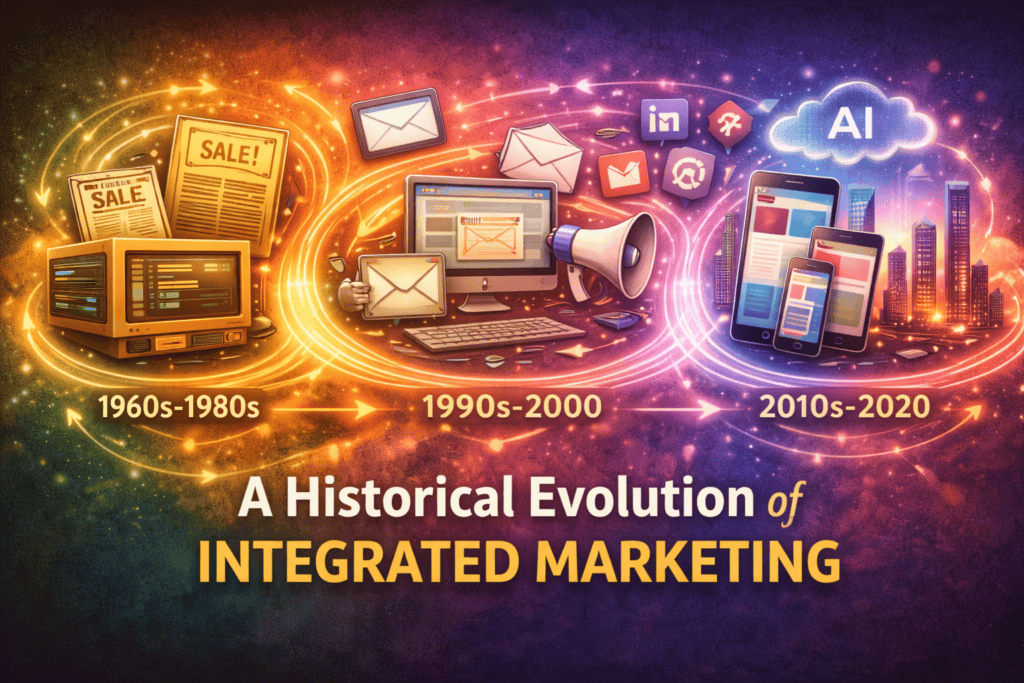
a historical evolution of integrated marketing

A Historical Evolution of Integrated Marketing

Reading Time: 3 minutes
1930s–1970s: Early Coordination and the Marketing Mix

1931 – Birth of brand management: Procter & Gamble’s Neil McElroy pens a now-famous memo establishing “brand men” to coordinate a product’s advertising and promotions. This dedicated focus on unified marketing for each brand becomes widely emulated as an early integrated strategy.

1942 – War Advertising Council unites messaging: The U.S. advertising industry forms the War Advertising Council (now the Ad Council) to rally support for WWII. It mobilizes agencies to push unified national campaigns across radio, print, and film, an early example of industry-wide integrated communications.

1960 – The 4 Ps framework: E. Jerome McCarthy introduces the 4 Ps of Marketing (Product, Price, Place, Promotion), emphasizing that promotion must work in conjunction with other elements of the marketing mix. This concept reinforces thinking about marketing in an integrated, strategic way rather than as isolated tactics.

1970s – Database marketing and early data integration: The advent of computer technology in the 1970s ushers marketing into the digital age. Companies begin harnessing databases and direct mail lists to target customers, gathering data on what works and why to inform strategy. These developments move marketing closer to customer-centricity and set the stage for Integrated Marketing Communications built on data-driven insight.

1980s: Drivers for Integration

1980s – Media fragmentation and global agencies: Cable TV, specialty magazines, telemarketing, and other new channels splinter audiences, making a single ad approach less effective. Large agency conglomerates expand globally, highlighting the need for unified campaigns across markets. Professional associations begin advocating for a comprehensive plan that coordinates PR, advertising, direct marketing, and sales promotion to ensure consistency and maximum impact.

1989 – IMC term and definition: The term Integrated Marketing Communications (IMC) is formally coined. It is defined as planning marketing communications with a comprehensive plan that combines multiple disciplines—advertising, public relations, sales promotion, direct response—to deliver clarity and a unified message for maximum impact. This marks the conceptual birth of integrated marketing as a distinct approach.

1990s: The IMC Revolution

1990–1991 – Academic and industry endorsement: Northwestern University launches the first Journal of Integrated Marketing Communications (1990) and an IMC graduate program (1991). A major IMC study finds that advertisers and agencies are embracing integration as a response to media fragmentation and new technologies. These developments legitimize IMC in both academia and practice.

1993 – IMC textbook and curriculum: Schultz and colleagues publish Integrated Marketing Communications: Putting It Together & Making It Work, the first IMC textbook. Medill restructures its curriculum around IMC, signaling a shift from siloed advertising education toward a holistic view of communications—treating the whole of marketing communications as more than the sum of its parts.

Late 1990s – Mainstream adoption: By the end of the decade, most major companies and agencies have embraced IMC. Campaigns increasingly coordinate messaging across TV, print, direct mail, and early digital channels. The discipline evolves from a buzzword into a standard approach for communications planning.

2000s: Digital Era Integration

Early 2000s – CRM and email marketing connect the dots: Businesses deploy Customer Relationship Management systems and email marketing at scale, enabling unified customer views and more consistent messaging across channels. CRM data is increasingly used to drive personalized communications and integrated campaign planning.

2004–2006 – Social media joins the mix: With the rise of Facebook, YouTube, and Twitter, marketers gain new channels for engagement. Brands begin integrating social media into campaign planning, ensuring consistent messaging across both traditional and digital platforms.

Late 2000s – Search and mobile integration: As search engines and smartphones reshape consumer behavior, marketers must integrate paid search, SEO, mobile, and offline efforts. Campaigns increasingly connect online and offline touchpoints into unified experiences.

2010s: Omnichannel and Martech Boom

2010 – Omnichannel concept emerges: The omnichannel approach moves beyond multi-channel by focusing on creating seamless experiences across all touchpoints. Retailers and service providers begin integrating physical and digital interactions to improve customer journeys.

2013 – Omnichannel becomes imperative: As smartphone adoption surges, customers increasingly move fluidly between online and offline environments. Marketers respond by unifying promotions, messaging, and data across every platform.

2010s – Martech explosion and marketing automation: Marketing technology tools grow rapidly, from automation to analytics platforms. This proliferation allows marketers to integrate campaigns, personalize messaging, and orchestrate cross-channel workflows—but also increases complexity, making integrated strategy more critical.

Late 2010s – Holistic customer experience: Marketing evolves toward customer-centric integration, aligning marketing, sales, and service touchpoints. Journey mapping and lifecycle design become core practices for delivering coherent experiences across the entire relationship.

2020s: Data, Omnichannel, and AI

2020 – Pandemic-driven integration shift: The COVID-19 pandemic forces rapid digital transformation. Brands with strong integrated foundations adapt quickly, aligning messaging across email, apps, social media, and virtual events while delivering consistent customer experiences.

2020–2022 – Short-form video and cross-platform storytelling: TikTok and similar platforms push marketers to develop channel-specific creative while maintaining consistent brand themes across formats. Integrated storytelling becomes essential.

2023 – AI in marketing workflows: AI becomes a common tool for content generation, personalization, and analytics. Marketing teams balance automation with oversight to keep messaging consistent and brand-aligned across channels.

Ongoing – Seamless experiences as the north star: Integrated marketing continues evolving toward coherent, customer-centered ecosystems. Regardless of new platforms or technologies, the focus remains on delivering unified brand experiences across every touchpoint.

A Historical Evolution of Integrated Marketing Read More »

Comparison of IMC and integrated marketing showing modern strategies like SEO, paid media, social, content, email, and analytics for system integration.

Why Integrated Marketing Needs A New Definition

Reading Time: 5 minutes

Ask ten marketers what integrated marketing means and you will probably hear ten different answers. Some will describe campaign planning.

Others will talk about product launches or cross channel messaging. Many are really describing what used to be called integrated marketing communications, or IMC.

The term has a lot of history and some baggage. But the work behind it is more important than ever.

Modern marketing only works when channels, data, content, and systems reinforce each other instead of operating in silos. That is the real promise of integrated marketing today.

Where Integrated Marketing Started The IMC Era

In the 1990s and early 2000s, integrated marketing was usually shorthand for integrated marketing communications. The focus was on campaigns and messaging. The core ideas were simple and useful.

  • Make sure the ad matches the landing page.
  • Use consistent creative across channels.
  • Align sales materials with marketing messages.
  • Coordinate media so customers see one clear story.

In practice, IMC often lived inside product marketing or brand teams. It was about message discipline and launch orchestration. When people said integrated marketing, they were usually talking about:

  • Product positioning and messaging.
  • Launch plans for new products or features.
  • Campaign calendars and media plans.
  • Ensuring that all assets looked and sounded on brand.

There is nothing wrong with that work. It still matters. The problem is that the world around it changed.

Why The Old Definition Falls Short Today

Digital marketing did not just add more channels. It changed how buyers buy, how systems connect, and how data flows. A few things happened that IMC was never designed to handle.

  • Customer journeys became nonlinear and messy.
  • Websites, apps, and products became core parts of the experience.
  • Analytics and tagging exposed relationships between channels.
  • Marketing stacks grew to include CRMs, CDPs, MAPs, and more.
  • Teams specialized around SEO, paid, lifecycle, content, and operations.

In this environment, matching the headline in an ad and the headline on a landing page is not enough. A marketer can have perfectly coordinated campaigns and still run a fragmented system that wastes spend and loses customers.

Modern integrated marketing has to include architecture, data, systems, and the full experience, not just communications.

What Integrated Marketing Should Mean Today

A more useful definition for integrated marketing in a digital world is this:

Integrated marketing is the architecture, orchestration, and optimization of the entire marketing ecosystem so every channel and system works together to move customers through a cohesive journey.

That definition makes a few important shifts.

  • It is about the ecosystem, not a single campaign.
  • It includes channels, content, data, and systems.
  • It cares about the journey, not only the message.
  • It focuses on how everything fits together, not just what each team does.

Integrated Marketing Versus Related Disciplines

Part of the confusion comes from overlapping job titles. Many teams now use other labels for pieces of this work.

  • Product marketing focuses on positioning, messaging, and launches for specific products.
  • Growth marketing focuses on experiments that drive acquisition, activation, and revenue.
  • Marketing operations focuses on workflows, processes, and the technical stack.
  • Lifecycle or retention marketing focuses on ongoing communication with existing customers.
  • Customer experience or CX focuses on the overall perception of the brand and interactions.

All of those are important. None of them fully answer the question integrated marketing should answer.

That question is: how does the entire marketing system work together as one engine.

The Name Has Baggage But It Is Still Useful

Given all that history, it is fair to ask if integrated marketing is still the right label. Some teams would rather talk about growth marketing, revenue marketing, marketing architecture, or marketing ecosystem design. Those terms can be helpful, but they are not widely shared or consistently defined.

Integrated marketing has two advantages.

  • People already search for it and recognize it as a serious discipline.
  • It invites a conversation about how well everything fits together.

The baggage is real. Many leaders still hear the term and think about coordinated campaigns from a previous era. That is also an opportunity. There is real value in explaining why the old definition is too narrow and what has to be added for the term to stay useful.

In other words, the name can stay. The meaning needs to grow up.

A Practical Way To Think About Integrated Marketing

One way to bring this idea down to earth is to picture your marketing as an engine rather than a collection of channels. Each channel has a defined role, and integrated marketing is the work of making the engine run smoothly.

At a high level, the ecosystem might look like this:

  • Strategy sets direction and defines who you serve and why.
  • SEO captures demand and brings people who are already searching.
  • Paid media generates demand and accelerates reach.
  • Content educates, builds trust, and answers questions.
  • Social media builds awareness and community.
  • Website and landing pages convert interest into action.
  • Email and lifecycle flows nurture, retain, and upsell customers.
  • Surveys and feedback loops surface insights from real customers.
  • Analytics and reporting reveal what is working and what is not.
  • Martech and operations connect data and automate delivery.

Integrated marketing asks questions at the system level, such as:

  • How does traffic from each channel behave once it reaches the website.
  • Where are people dropping off in the journey.
  • Which content assets support multiple channels at once.
  • How do campaigns, evergreen content, and lifecycle flows reinforce each other.
  • Where does data get lost between systems.

The goal is to design and improve the connections so that every part of the engine is pulling in the same direction.

How To Start Modernizing Integrated Marketing In Your Team

Moving from an IMC mindset to a true integrated marketing mindset does not require a full reorg. It starts with a few deliberate steps.

Step 1 Map The Ecosystem

List your main channels, tools, and systems. Draw how traffic flows today. Include where data is captured, how contacts are created, and what happens after someone converts.

Step 2 Clarify The Role Of Each Channel

Decide what each channel is responsible for. For example, one channel might focus on demand capture, another on demand creation, and another on retention. This prevents everything from trying to do everything.

Step 3 Connect The Journey

Identify the most common paths people actually take. Look for dead ends, such as emails that go to generic pages or social posts that send people into a maze. Make simple fixes that keep people moving toward a clear outcome.

Step 4 Align Measurement With The System

Update your reporting so it reflects how channels work together, not just how they perform in isolation. Include journey views, assisted conversions, and cross channel breakdowns where possible.

Step 5 Improve One Connection At A Time

Modern integrated marketing is iterative. Choose one high value connection, such as search to landing page to email nurture, and make that flow smoother. Then move to the next weak link.

Why This Shift Matters

When integrated marketing is treated as nothing more than campaign coordination, it becomes a box to check. The team matches taglines and calls it a day. The result is pretty creative that still underperforms.

When integrated marketing is treated as ecosystem design, the focus shifts to how each decision affects the whole system. Spend becomes more efficient. Customer experiences feel more coherent. Teams understand how their work supports the bigger picture.

The term may be old, but the work is not. Updating what integrated marketing means inside your organization can be one of the most important changes you make.

Why Integrated Marketing Needs A New Definition Read More »

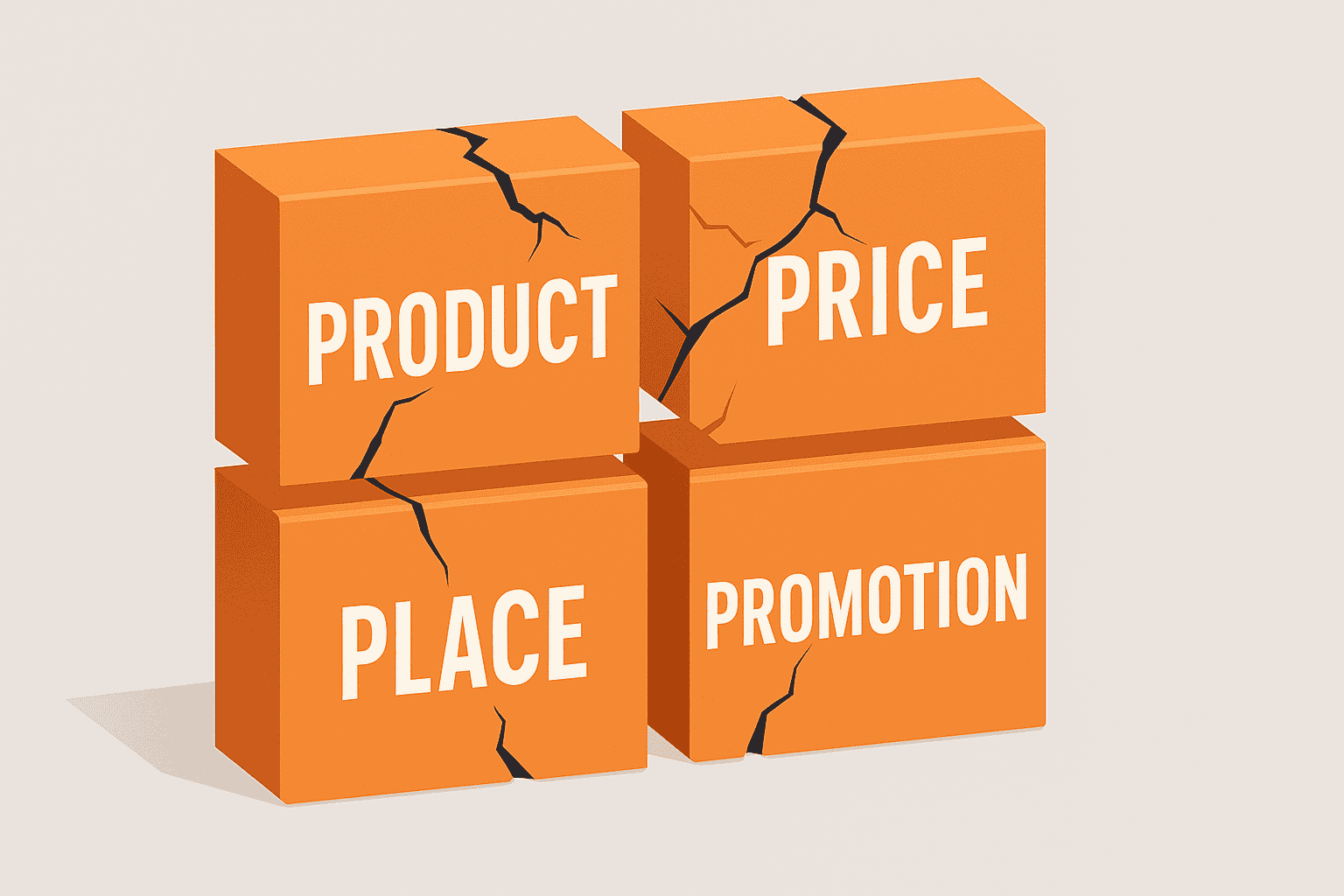
marketing 4 Ps are dead

The Marketing 4 Ps Are Dead

Reading Time: 6 minutes

No, this isn’t clickbait. (And no, this isn’t like the perennial false alarm that “SEO is dead” – it’s not.) The classic 4 Ps of Marketing – Product, Price, Place, and Promotion – have outlived their usefulness in guiding modern marketing strategy.

The 4 Ps framework came about in 1960, introduced by E. Jerome McCarthy, a marketing professor at Michigan State University who would later be honored with the AMA Trailblazer Award and recognized as a top thought leader in marketing.

McCarthy’s 4 Ps concept (also known as the marketing mix) was first popularized in his textbook Basic Marketing: A Managerial Approach and became the cornerstone of marketing education for decades. It’s likely the first thing taught in any introductory marketing class. In my own MBA program (just this year), the marketing course still drilled the 4 Ps as a fundamental model.

Yet a lot has changed in the world since the 1960s, and unfortunately the 4 Ps no longer provide a proper foundation for marketers. The framework was conceived in an era dominated by manufacturing and tangible products – before widespread digital technology, before the internet, even before barcodes. For several decades the 4 Ps were incredibly valuable, giving businesses a simple roadmap to engage consumers and build competitive advantage. But today’s marketing environment bears little resemblance to that world. What once was a foundational model is now increasingly viewed as outdated and dangerously incomplete.

Below, I’ll briefly introduce the 4 Ps and then outline five key reasons why the 4 Ps framework is no longer sufficient in modern marketing.

What Are the 4 Ps of Marketing (and Why Were They Useful)?

The “4 Ps” of marketing refer to the four pillars of a traditional marketing strategy: Product, Price, Place, and Promotion. In a nutshell, this framework says that to successfully market something, you need to get the product right (offer something that meets customer needs), set the right price, distribute it in the right places, and promote it effectively to your target audience.

This concept was revolutionary in the mid-20th century because it organized marketing activities into a clear, actionable checklist. For decades, the 4 Ps model provided companies a practical roadmap for crafting campaigns and allocating resources – it fueled the growth of countless brands and even helped shape entire industries.

Why was it so valuable for so long? In the manufacturing-heavy economy of the 1960s–1980s, most businesses sold physical products. The 4 Ps gave managers a structured way to think about bringing those products to market: develop a good product, price it attractively, place it in stores (or sales channels) where customers can find it, and promote it via advertising and sales tactics. It was a simple, intuitive framework that was easy to teach and understand. However, marketing has evolved dramatically since then – and as we’ll see, the 4 Ps haven’t kept up.

Five Reasons the 4 Ps Framework Is No Longer Sufficient

  1. Marketing Only Controls One “P.” Perhaps the biggest practical flaw with the 4 Ps today is that in many companies, the marketing department only truly controls one of those Ps: Promotion. Product strategy is often owned by product development or R&D teams; Pricing is decided by finance or executive leadership; Place (distribution) might be handled by sales or logistics teams. Marketing, in practice, is frequently relegated to communications and advertising – i.e. the Promotion P. Recent industry surveys confirm this reality: only about one-third of marketers have any influence over their company’s pricing or distribution decisions, whereas nearly 89% do control advertising and communications. In other words, the classic 4 Ps model describes areas of decision-making that marketing as a function often doesn’t own. Teaching new marketers that they should manage all four areas sets an unrealistic expectation and ignores the siloed nature of many organizations. If “Marketing = 4 Ps” but marketers only execute one of those, the framework loses a lot of its relevance.
  2. It Ignores the Rise of Services. The 4 Ps were conceived in a product-centric era – the 1960s economy of mass-produced goods. But we no longer live in a strictly product-dominated world; services make up a huge part of modern economies (think finance, healthcare, software-as-a-service, consulting, etc.). The traditional 4 Ps framework doesn’t account for the unique challenges of marketing services, which are intangible and often involve customer experiences rather than physical goods. In fact, this gap was noticed decades ago: by the 1980s marketers had introduced three additional “Ps” (People, Process, and Physical evidence) precisely to adapt the marketing mix for services marketing. Those added elements cover things like service personnel, service processes, and the tangibles that shape a service experience – factors completely ignored by the original 4 Ps. A service business (e.g. a hotel, a bank, or a tech platform) can’t be fully described by just product, price, place, promotion. For instance, customer support process or the ambiance of a hotel lobby are crucial to the offering but don’t fit neatly into any of the original four categories. The result is that using only the 4 Ps provides an incomplete toolkit for marketers in service-driven industries.
  3. Brand Is Not One of the Ps. One glaring omission in the 4 Ps model is Brand – arguably the most important asset in marketing. Branding transcends any single “P”: it’s bigger than the product itself, and more enduring than any one promotion or price tactic. Yet the framework doesn’t explicitly include brand strategy at all. Marketing thought leaders have pointed out that “Brand comes before marketing” and that leaving brand out of the core framework means neglecting the primary driver of long-term customer preference. A strong brand is what creates loyalty, trust, and the long-term equity that makes customers buy a company’s product repeatedly (and even pay a premium for it). The absence of brand in the 4 Ps has led to overemphasis on short-term promotion at the expense of sustainable brand-building. Even Philip Kotler – the very scholar who helped cement the 4 Ps into marketing orthodoxy – has updated his thinking on this. Kotler now advocates an expanded 7-component marketing mix that explicitly adds Brand as a key element, noting that a trusted brand supplies extra value to customers and must be managed alongside product and price. If the “father of modern marketing” himself has added Brand to the mix, it’s a clear sign the original model was missing something crucial.
  4. It’s Not Customer-Centric (Inside-Out vs. Outside-In). Another fundamental criticism is that the 4 Ps framework is inward-looking and product-centric, rather than starting with the customer’s perspective. By design, it begins with a company deciding on a product, setting a price, determining distribution, and then promoting – an inside-out approach. Modern marketing, however, preaches outside-in thinking: start by understanding customer needs and desires, then build solutions (products or services) around those, and communicate in customer-centric ways. The 4 Ps make no mention of the customer at all! It’s assumed that if you get the product, price, place, promotion right, customers will buy – but this assumption often fails if you haven’t first figured out what the customer actually wants. This is why alternative frameworks like the 4 Cs were proposed in the 1990s (Consumer needs, Cost to the customer, Convenience, Communication) to reframe these elements from the buyer’s viewpoint. Even with later tweaks, the 4 Ps model remains “trapped within the original structure, which is product-centric. It starts with the product, not the customer, an approach which most marketers threw over years ago.” In today’s era of customer experience and relationship marketing, a framework that doesn’t put the customer front-and-center is fundamentally flawed.
  5. It’s Outdated in the Digital Age. Finally, the 4 Ps are simply a product of a different time. The framework was born over 60 years ago in a business environment that had no internet, no smartphones, no social media, no eCommerce – essentially none of the technological and cultural shifts that define today’s markets. Marketing in 2025 is about managing online and offline experiences, leveraging data analytics, engaging through digital communities, personalizing content, and iterating rapidly. The rigid 4 Ps model assumed a relatively static world where companies produced goods, pushed them out to retailers, ran some ads, and called it a day. That linear model doesn’t reflect how modern marketing works. Today, places are not just physical stores – they’re digital platforms and global supply chains. Promotion is no longer one-way advertising – it’s often two-way engagement and real-time conversations. Even the concept of price is more dynamic (think subscription pricing, freemium models, surge pricing algorithms). The old 4 Ps framework wasn’t built for this level of complexity and change. As one commentator put it, the 4 Ps “assume a static, unchanging marketplace” – which in our time is almost laughable. In an age of rapid disruption and empowered consumers, clinging to a 1960s-era checklist can cause marketers to miss the bigger picture. It can even hinder strategic thinking by focusing too narrowly on tactical levers and not enough on adaptation, innovation, and long-term value. Little wonder that experts say the 4 Ps are past their retirement age.

Closing Thoughts

None of this is to say that product, price, place, and promotion don’t matter anymore – they do. But they’re hygiene factors now; they’re simply not the whole story of what marketing entails today. The 4 Ps framework served its purpose in a bygone era, but continuing to rely on it as the primary model for marketing is like using a typewriter in the age of cloud computing. 

Marketing has outgrown the 4 Ps, and it’s time we acknowledge that in both business practice and marketing education. In a future blog post, I will explore some of the better frameworks emerging to replace the 4 Ps – models that are more customer-centric, more inclusive of services and brand, and more attuned to the digitally driven, purpose-driven world we actually live in. For now, the key takeaway is that the old playbook needs an update. The marketing discipline must evolve beyond the 4 Ps or risk getting stuck in the past while the world moves on.

References

Max Abraham. Marketing Mix: Traditional 4Ps to Evolution of Marketing 7Ps. Management.org, Aug 27, 2024.
https://management.org/marketing-mix-4ps-to-7ps

Vincent van Vliet. E. Jerome McCarthy Biography (Marketing Mix – 4Ps). Toolshero, Apr 16, 2025.
https://www.toolshero.com/marketing/e-jerome-mccarthy/

Christian Sarkar & Philip Kotler. The 5th P is Purpose. The Marketing Journal, Mar 13, 2025.
https://www.marketingjournal.org/the-5th-p-is-purpose-kotler-sarkar/

Philip Kotler. The Past, Present, and Future of Marketing (Insights). AMA.org, Mar 12, 2024.
https://www.ama.org/marketing-news/the-past-present-and-future-of-marketing-insights-from-philip-kotler/

Helen Edwards. The 4Ps are wrong and out of date — please don’t bring them back! WARC, Sep 2023.
https://www.warc.com/content/paywall/article/warc-exclusive/the-4ps-are-wrong-and-out-of-date-please-dont-bring-them-back/151321

Charlotte Rogers. Most marketers don’t have influence over the 4Ps excluding promotion. Marketing Week, May 21, 2025.
https://www.marketingweek.com/marketers-influence-4ps-promotion/

The Marketing 4 Ps Are Dead Read More »

case study united airlines passenger dragged crisis

Case Study: United Airlines and the Passenger Dragging PR Crisis

Reading Time: 3 minutes

Brief Summary

In April 2017, United Airlines faced a massive public relations crisis after a paying passenger was violently dragged off an overbooked flight by airport security.

Video footage of the bloodied passenger went viral worldwide, sparking international outrage and calls for change.

The incident quickly became a textbook example of how a single customer service failure can erupt into a global reputational nightmare, underscoring the importance of empathy and swift crisis management in modern marketing.

Company Involved

United Airlines is the major American airline at the center of this story, headquartered in Chicago and one of the world’s largest carriers.

Marketing Topic

The primary themes in this case are Customer Experience and Crisis Response, showcasing how frontline behavior and initial brand messaging can influence global perception, trust and long-term reputation.

Public Reaction or Consequences

The reaction was overwhelmingly negative. The video became the top trending topic on Chinese social platform Weibo with over 580 million posts. Outrage escalated into viral calls to boycott United, politicians demanded investigations into overbooking, and the airline’s approval rating dropped below the U.S. president’s at the time. The stock price initially fell and the company reached a legal settlement with Dr. Dao within weeks. The brand damage was severe and long-lasting.

Why It Matters Today

This moment showed that public backlash can scale globally in hours, that customer treatment outweighs advertising spend, that corporate tone determines public reception, and that crisis response must prioritize humans before statements. It also forced the airline industry to change policies and rethink involuntary passenger removal.

3 Takeaways

1. Customer experience outweighs messaging, slogans, campaigns and brand claims.

2. A fast, human, accountable response beats a slow, scripted or defensive statement.

3. Empowering employees to resolve conflict prevents global brand crises.

Notable Quotes and Data

“No one should ever be mistreated this way.” United CEO Oscar Munoz, public apology.

“United Airlines was more unpopular than Donald Trump.” Newsweek public sentiment report.

United introduced compensation up to $10,000 to avoid involuntary bumping.

Full Case Narrative

On April 9, 2017, United Airlines Flight 3411 was overbooked because four crew members needed seats. No passengers accepted a $800 voucher to volunteer to leave the flight. The airline then involuntarily selected four passengers. One of them, Dr. David Dao, a 69-year-old physician, refused to give up his seat, explaining he had patients to treat the next day.

Security officers were called to remove him. During the removal, his face struck an armrest, knocking him unconscious, bloodying him and causing significant visible injuries. Other passengers recorded the event, including footage of his limp body being dragged down the aisle. The video spread across social media within hours, triggering global outrage.

The next day, United released a statement apologizing for “re-accommodating” passengers, a phrase that was widely criticized as minimizing the incident. A leaked internal memo described Dr. Dao as “belligerent,” further escalating backlash. Public outrage intensified, leading to #BoycottUnited and unprecedented media coverage.

The CEO later released a public apology calling the incident “truly horrific,” acknowledging wrongdoing, promising it would never happen again, and launching a formal policy review. Within 18 days, the company settled with Dr. Dao for an undisclosed sum and introduced major policy changes, including banning forcible removals of seated passengers, increasing volunteer compensation up to $10,000, retraining staff, and shifting internal incentives toward customer experience outcomes instead of operational targets alone.

This crisis revealed a systemic cultural issue: frontline staff were following policy, not solving a human problem. The controversy demonstrated that internal procedure must never override customer dignity, safety or emotional intelligence. Years of branding, advertising and loyalty incentives were overshadowed by a single recorded moment.

Timeline

April 9, 2017: Incident occurs onboard United Flight 3411 and is recorded by passengers.

April 10, 2017: United issues its first statement referencing “re-accommodation,” triggering backlash.

April 11, 2017: CEO issues a full apology, calling the event horrific and unacceptable.

April 27, 2017: United announces settlement with Dr. Dao and major policy overhauls.

What Happened Next?

Security officers involved were later fired or suspended. Airlines across the U.S. updated overbooking policies, increased voluntary compensation, and reduced involuntary removals. Customer complaints dropped significantly year-over-year after the incident. United rebuilt operational policy, internal culture, incentives and training to prioritize dignity over rigid protocol. The incident remains a landmark case in PR, crisis communication, customer experience and corporate accountability.

One Sentence Takeaway

One customer moment, captured and shared, can outweigh decades of brand investment, advertising spend and loyalty building.

References

Newsweek: David Dao settlement report

Los Angeles Times: United policy changes

Al Jazeera: Official apology coverage

CBS News: CEO interview and quotes

WTTW Chicago: Long-term industry impact

WTTW Chicago: Officer terminations

Case Study: United Airlines and the Passenger Dragging PR Crisis Read More »