Last updated August 2026
Most companies occupy an unremarkable place in our lives. We pay the bill. We renew the registration. We deal with the HOA. We file the taxes.
The relationship is low engagement and low trust. We don’t expect much. We just want it to require as little attention as possible.
When one of those relationships suddenly demands more attention, it’s usually because something that was supposed to happen automatically stopped working.
Then there’s a much smaller group of companies: the ones we actually choose.
We like what they do. We trust them. We’ve used them for years, maybe decades. We recommend them to other people. In marketing terms, we’ve moved past being customers and become fans.
That’s an incredibly valuable relationship.
Which is why it’s strange when companies that have earned that trust keep reminding me they aren’t paying attention.
You Already Know This About Me
I’ve been an Audible customer since before it was part of Amazon. Over the years I’ve bought and rated hundreds of books.
Netflix is similar. I was a customer back when the experience meant a DVD in the mail. I’ve rated an enormous number of movies and shows there too.
In both cases, I’ve spent years explicitly telling these companies what I like and don’t like. That’s valuable data.
My expectation isn’t ambitious. I’d love for that history to help these companies recommend things I haven’t discovered yet. But let’s set the bar lower.
Even if you don’t know what to recommend, just don’t recommend something I’ve already consumed and rated.
Yet recommendations are still routinely filled with content I already own, have watched, or have rated. I’m not asking for futuristic AI. I’m asking the company to remember what I already told it.
Sometimes the Data Doesn’t Even Survive the Transaction
Costco gives me another version of the same experience. I like Costco. I trust Costco. I spend plenty of money there.
But when I pick up a prescription, I’m routinely asked for my birthdate twice. I provide it once. Something happens while my prescription is located and prepared. Then I’m asked again.
The employees sometimes seem almost as aware of the absurdity as I am.
This isn’t sophisticated personalization. It isn’t a recommendation engine. It isn’t even remembering something from six months ago.
The information couldn’t make it from one step of the same interaction to the next.
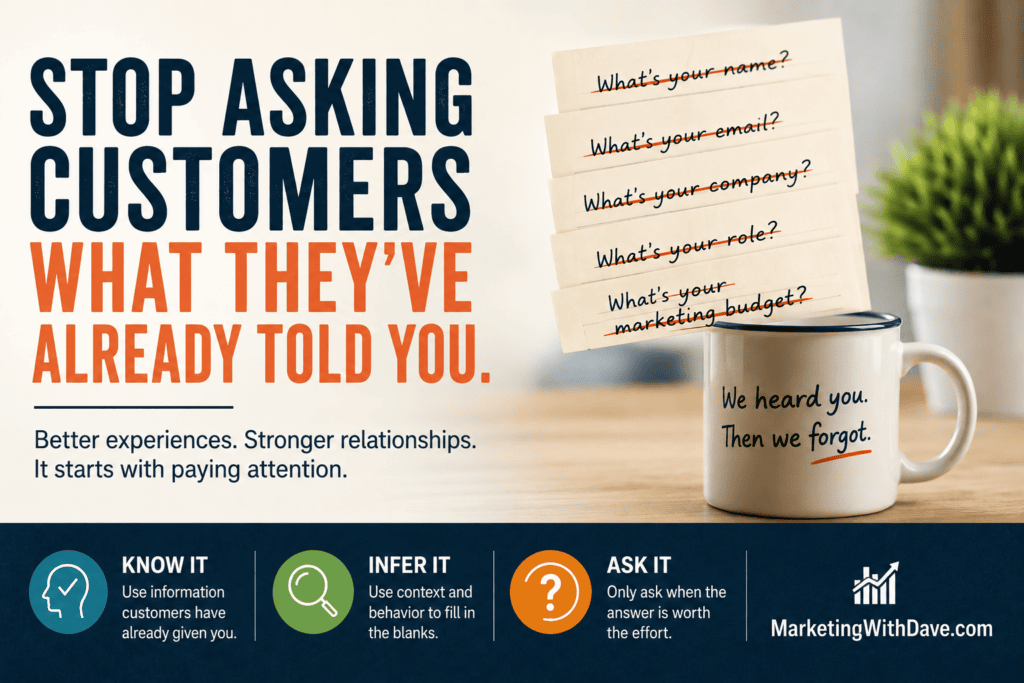
Every time that happens, the company is communicating something about the systems behind the experience: we heard you, then we forgot.
Marketers Are Guilty Too
It would be easy to blame legacy systems, disconnected databases, or slow-moving organizations. I’m not sure we have room to criticize.
There are marketing companies whose webinars I’ve attended repeatedly. Every month, I fill out the same registration form: name, email, company, role, marketing budget, maybe another qualification question. Then the next webinar comes along and we start over as though we’ve never met.
That’s a missed opportunity. If you already have my name, company, role, and budget, why ask again? More importantly, isn’t there something else you’d rather learn about me?
That’s the idea behind progressive profiling: instead of repeatedly asking for the same information, use what you already know and gradually learn something new.
If you know my role, ask about my biggest challenge. If you know my company size, ask which channels I manage. If you know my budget, ask what I’m trying to improve this quarter.
Each interaction can make the relationship richer. Or you can ask me for my marketing budget a fifteenth time.
Personalization Doesn’t Have to Be Impressive
The marketing industry makes personalization sound complicated: customer data platforms, predictive models, AI, identity resolution, real-time engines.
Those technologies can create powerful experiences. But there’s a more basic level many companies still haven’t mastered:
Remember what the customer already told you.
Before predicting what someone wants next, make sure you aren’t asking a question they already answered. Before recommending a product, make sure they don’t already own it. Before showing an offer, check whether they already responded to it. Before asking what they’re interested in, look at what they’re currently doing.
Sometimes the smartest personalization decision isn’t showing someone something more relevant. It’s simply not showing them something obviously irrelevant.
Ignoring Customer Data Quietly Erodes Trust
None of these are catastrophic experiences. I haven’t canceled Audible over a duplicate recommendation. I haven’t canceled Netflix over a rated show resurfacing. I haven’t stopped shopping at Costco over a repeated birthdate question.
That’s exactly why this problem is easy to dismiss. These aren’t dramatic failures. They’re tiny withdrawals from the trust account. Each one says, in some small way: we don’t remember you, we aren’t connecting what you told us yesterday with what we’re asking today, we’re collecting your data without using it to improve your experience.
Trusted brands have goodwill to absorb those moments. But customer expectations don’t stand still. Eventually another company enters the market and makes the old experience feel unnecessarily difficult.
The incumbent hasn’t gotten worse. The expectation got better.
This Is a Philosophy I Want to Protect
I’ve been thinking about this while building SiteSqueeze, which is designed around a simple idea: help website owners do more with the traffic they already have.
As the product evolves, one principle stays near the center: use the context you already have before asking the visitor to do more work.
That leads to three simple rules I want to keep in mind whenever SiteSqueeze asks a visitor for information:
- Know it before you ask it. If the visitor has already given you the information, don’t make them provide it again.
- Infer it before you ask it. If the page, referral source, campaign, behavior, or previous interaction already gives you enough context, use that first.
- Only ask when the answer is worth the effort. Every field creates friction, so the information should meaningfully improve what you can do for the visitor.
Put another way: know it → infer it → ask it.
A website already knows a lot about the current interaction. What page is someone viewing? What category does it belong to? How did the visitor arrive? What promotion have they already seen? What have they clicked, and what have they ignored?
There can eventually be much richer context than that. But the goal isn’t collecting every possible piece of data. It’s using the information that’s genuinely useful to create a better interaction.
If someone is reading their fourth article about analytics, you probably don’t need to ask if they’re interested in analytics. If they arrived through a campaign URL, you probably don’t need to ask how they heard about you. If they’ve already responded to an offer, you probably shouldn’t keep showing it. If they repeatedly ignore a promotion, that’s information too.
This isn’t about creepy personalization. It’s about respecting the visitor enough to pay attention.
The Question Every Marketer Should Ask
We spend a lot of time trying to collect more customer data: more form fields, more surveys, more tracking, more behavioral signals, more integrations.
Before collecting another piece of information, there’s a more useful question: what are we already collecting that we aren’t using?
And a less comfortable one: what are you doing today that reminds your customers you’re either deaf or lazy about their world?
Your customers may have already told you what they need. The next step isn’t always asking another question. Sometimes it’s proving you were listening.