Last updated September 2026
AI Search visibility software is getting very good at measuring things. Visibility scores, mentions, citations, sentiment, competitors, prompts, rankings, and share of voice are becoming standard features.
But measurement is only useful if it answers a more practical question: what should I do next?
That question became important as I tested AI Search visibility platforms on MarketingWithDave.com. The tools use similar language such as recommendations, opportunities, audits, tasks, next steps, fixes, and agents. But once I looked closely at the actual feedback, they were solving very different problems.
One platform crawled hundreds of pages looking for technical issues. Another analyzed a single page I selected and told me exactly where the content could improve. Another studied what large language models were citing and recommended where I should participate off-site. Another could draft and publish Reddit responses.
So instead of comparing feature names, I looked at something more useful: how well does each platform help a marketer figure out what to do next?
How the Platforms Cover On-Page, Off-Page, and Technical Feedback
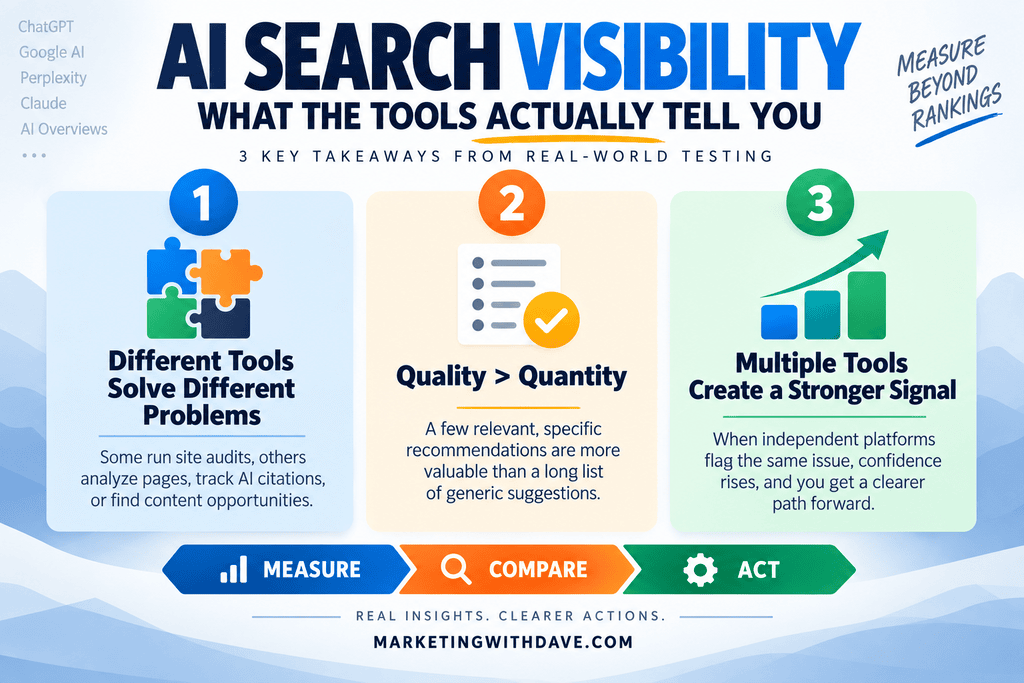
The first challenge is that these platforms do not operate at the same level. Some run broad site audits, while others focus on individual pages, AI citation ecosystems, or content opportunities.
| Platform | On-Page Feedback | Off-Page Feedback | Technical Feedback | General Approach |
|---|---|---|---|---|
| SnowSEO | Strong traditional audit coverage | Limited and relatively generic | Strong sitewide technical audit plus GEO readiness checks | Find problems, prioritize them, explain them, and assist with some fixes |
| Nuwtonic | Strong page-level recommendations when you provide a URL | Not meaningfully demonstrated in my testing | Limited; not a traditional sitewide technical audit | Analyze a page you choose and suggest specific improvements |
| ZeroRank | AI-informed content type and content opportunity recommendations | Excellent and unusually specific | Focused more on AI readiness than traditional technical SEO | Study what AI systems cite and turn that intelligence into opportunities |
| iGEO | More oriented toward content creation than auditing | Reddit opportunity discovery with drafting and publishing workflow | Limited evidence of traditional technical recommendations | Identify an opportunity and help create content or responses |
| Visby | Broad sitewide recommendations | Backlinks, social profiles, authority, reviews, and brand presence | Strong performance and technical recommendations | Create a broad strategic work backlog with detailed completion criteria |
Visby is included here as a reference point, though it is not part of my primary four-platform AI Search software comparison.
On-Page SEO Feedback
On-page recommendations were a clear example of why feature lists can mislead. Several platforms can truthfully say they provide on-page recommendations, but the type and depth of feedback varies substantially.
SnowSEO: Traditional Audit Findings at Scale
SnowSEO treats on-page optimization largely as an audit problem. It crawls the site and flags issues such as titles, meta descriptions, image ALT text, headings, and thin content.
The advantage is coverage: I don’t have to decide which URLs to inspect, and SnowSEO can identify patterns across hundreds of pages. The disadvantage is familiar to anyone who has used SEO audit software before: finding an issue doesn’t mean the issue matters. A technically valid warning can still be low priority, irrelevant to the business, or not worth the effort to fix.
Nuwtonic: Narrower Scope, Deeper Page Feedback
Nuwtonic takes nearly the opposite approach. It doesn’t run a broad sitewide audit in my testing; I provide a page, and it analyzes that specific page.
For my SnowSEO review, Nuwtonic produced recommendations covering metadata, content additions, missing topics, competitor analysis, and editorial improvements. The most useful ones were highly contextual, identifying where in the article new information belonged rather than just saying it needed more content. It also flagged potential duplication between sections, which was accurate: that older review format did contain more repetition than the format I use today.
SnowSEO is better positioned to tell me which pages may have problems. Nuwtonic is better positioned to go deeper on a page I already decided deserves attention.
ZeroRank: On-Page Recommendations Driven by AI Citation Patterns
ZeroRank’s on-page recommendations don’t feel like a traditional SEO audit at all. It looks at the types of pages and content that large language models are citing and recommends formats that may improve visibility.
For MarketingWithDave, its recommendation categories included product pages, category pages, articles, listicles, discussions, and profiles. For each type, it showed examples of domains being cited, common phrases and themes, and a small number of prioritized recommendations.
This feels less like “fix this page” and more like “based on what AI engines are citing, here are the assets worth creating.” That makes ZeroRank’s on-page feedback more strategic than diagnostic.
Visby: A Broad Backlog of Site Improvements
Visby generated 52 tasks in my account, including reviewing meta titles and descriptions, improving heading hierarchy, adding descriptive ALT text, improving internal linking, adding semantic HTML, improving home page authority and clarity, adding testimonials and case studies, and strengthening brand differentiation.
What I initially missed was how detailed each task actually is. Its ALT text recommendation, for example, included a priority level, the affected page, a task objective, an example image with an empty ALT attribute, an explanation of why it matters, specific steps to take, acceptance criteria, and a post-completion validation step. That’s materially better than simply adding “missing ALT text” to a dashboard.
Off-Page SEO and AI Visibility Feedback
Off-page recommendations produced the largest difference between the platforms. Traditional SEO often reduces off-page work to backlinks, citations, digital PR, reviews, and brand mentions. AI Search makes this more interesting because external conversations can directly shape what answer engines retrieve and cite.
ZeroRank Is the Standout for Off-Page Recommendations
ZeroRank’s off-page recommendations cover a surprisingly broad set of external platforms, including Reddit, YouTube, Trustpilot, Capterra, G2, Product Hunt, LinkedIn, Quora, TrustRadius, and other review and community sites.
More importantly, it doesn’t just say “you should have a Reddit presence.” It identifies specific communities, existing discussions, topics, and opportunities where MarketingWithDave could participate. That difference is enormous:
Generic: Build your Reddit presence.
Specific: Participate in a relevant subreddit or existing conversation that is already influencing AI answers in your category.
Both can technically be called recommendations. Only one gives the marketer a clear next action.
SnowSEO: Broader Coverage, Lower Specificity
SnowSEO’s GEO audit also recommended external presence on sites such as Reddit, YouTube, G2, Capterra, Trustpilot, and Crunchbase, but the recommendations were generally much broader than ZeroRank’s. Identifying that Reddit matters is different from identifying the specific subreddits, threads, or topics that appear to influence AI answers.
Visby: Authority, Backlinks, and Brand Presence
Visby’s off-page tasks focused on improving the backlink profile, building backlinks with branded anchor text, maintaining consistent social profiles, expanding YouTube and Google visibility, monitoring brand confusion on social channels, and strengthening external evidence for testimonials and authority claims. These are broader than ZeroRank’s opportunity-level guidance, but they show Visby treating off-site authority as part of a larger brand and entity strategy rather than backlinks alone.
iGEO: Narrower Discovery, More Execution
Its workflow identifies high-intent Reddit discussions where buyers may be deciding what to use, then drafts a response, lets the user regenerate or edit it, runs safety checks, and moves toward approval and publishing.
That creates an interesting contrast: ZeroRank provides much broader off-page intelligence and opportunity discovery, while iGEO goes further toward execution once a Reddit opportunity has been identified. The better product depends partly on which problem you need solved.
Technical SEO and AI Readiness Feedback
Technical recommendations were another area where similar labels hid very different capabilities.
SnowSEO: The Closest Thing to a Traditional Technical SEO Audit
SnowSEO’s crawl covers broken links, HTTPS and HSTS, redirects, unused JavaScript and CSS, render-blocking resources, page weight, accessibility, robots.txt, image sizing, heading issues, and deprecated HTML.
It also has an Auto Fix capability for some technical and metadata problems. One good example: it proposed replacing an old HTML <center> tag with modern markup, which is genuine remediation rather than just reporting the issue. But automatic execution shouldn’t be mistaken for successful execution. I also tried Auto Fix on a missing H1 on my /posts page, and it returned an error.
The real distinction isn’t whether a product has an Auto Fix button. It’s what it can fix, how meaningful those fixes are, and whether they actually work.
SnowSEO’s GEO Audit Is Separate From Its Traditional Audit
SnowSEO also runs a separate GEO audit covering Organization, Person, and Article schema, machine-readable content, markdown representations, AI crawler access, content signals, external answer-engine presence, agent and API discovery standards, and emerging agentic commerce protocols.
This audit is unusually broad, but that breadth creates noise. Some findings were useful; others were irrelevant to MarketingWithDave today, and some appeared inaccurate. It recommended hreflang tags despite the site being English-only with no alternate language versions, and reported a missing blog page despite the site being built heavily around blog content. Several recommendations involving APIs, MCP, agent discovery, and machine payment protocols may be technically interesting without being meaningful priorities today.
The clearest lesson from this: a failed audit check is not necessarily a problem worth fixing.
ZeroRank: AI Readiness Rather Than Traditional Technical SEO
ZeroRank’s technical checks are better described as an AI Readiness audit: llms.txt, robots.txt, sitemap.xml, HTTPS, JSON-LD, Organization/Article/Product/FAQ/HowTo schema, Open Graph, Twitter Card, canonical URLs, author signals, breadcrumbs, PageSpeed, and agent readiness signals.
ZeroRank scored MarketingWithDave 75 for AI Readiness in one test. One of the more important findings was a mobile PageSpeed score of 35, which matters because Visby independently produced multiple recommendations around performance, Core Web Vitals, unused JavaScript, render-blocking CSS, caching, and image delivery. Agreement between independent tools is far more interesting to me than a single vendor’s warning.
Visby: Strong Technical Task Detail
Visby’s technical recommendations covered lazy loading, modern image formats, responsive image sizing, unused and third-party JavaScript, render-blocking CSS, cache lifetimes, font display behavior, and Core Web Vitals. Its strength is less about surfacing a completely unique issue and more about converting issues into structured, actionable work.
The Number of Recommendations May Be the Wrong Metric
At one point I had dozens of SnowSEO audit findings, 18 Nuwtonic recommendations for a single page, 52 Visby tasks, and a small number of highly curated ZeroRank opportunities.
Those numbers are nearly meaningless compared directly. Visby’s 52 tasks don’t make it three times more useful than Nuwtonic’s 18. ZeroRank showing three opportunities doesn’t mean it provides less value than a tool producing 50 warnings. The better question is: how good is the feedback?
How I Think Recommendation Quality Should Be Evaluated
I’m still refining this framework, but testing suggests several dimensions matter more than raw recommendation count.
1. Relevance
Does the recommendation actually apply to the website, business, and strategy? SnowSEO’s hreflang recommendation is a useful example: missing hreflang could matter greatly for a multilingual site, but it’s meaningless for a site with only one language version.
2. Accuracy
Is the problem or opportunity actually real? This matters even more now that recommendations are increasingly AI-generated. One striking example: while analyzing my SnowSEO review, Nuwtonic inserted “Nuwtonic Agent” twice among its suggested topic entities. A tool analyzing a competitor’s review shouldn’t contaminate the recommendation with its own product terminology, which is exactly why AI-generated SEO recommendations still require human review.
3. Importance
Does the platform distinguish meaningful opportunities from technical trivia? A website can have hundreds of technically imperfect elements without fixing every one being a productive use of time.
4. Specificity
Does the tool tell you exactly where the issue or opportunity is? “Improve backlinks” is a recommendation. “Participate in this specific community because it’s influencing AI answers for your category” is a much better one.
5. Prioritization
Does the platform help determine what should happen first? SnowSEO’s Next Steps view consolidates technical, search, and AI visibility findings into a ranked task board rather than forcing the user to interpret every audit independently.
6. Actionability
After reading the recommendation, do I understand what to do? Visby’s ALT text task is a strong example because it moves beyond detection into instructions and completion criteria.
7. Assistance
Does the platform help complete the work, through suggested replacement text, AI fix prompts, drafted content, step-by-step instructions, or examples from competing or cited sites?
8. Execution
Can the platform actually make the change? SnowSEO can automatically address certain technical and metadata issues. Nuwtonic’s agents can assist with and implement some SEO/GEO changes. iGEO can take certain Reddit opportunities through drafting and approval toward publishing. Execution should be judged by what the platform can actually do successfully, not by whether an Auto Fix feature exists.
9. Validation
Can the tool verify afterward that the task was completed? Visby’s workflow explicitly includes acceptance criteria and validation, an unusually useful final step.
From Finding a Problem to Knowing It Was Fixed
The recommendation systems I tested fall somewhere along this progression: Detect → Explain → Prioritize → Prescribe → Assist → Execute → Validate.
Not every tool needs to reach the final stage to be valuable. A strategic recommendation, such as ZeroRank identifying an important external conversation, may never be something software should automatically execute. But this progression is useful because it exposes the difference between a tool that just creates another list of problems and one that actually reduces the marketer’s workload.
Signal vs Noise: What Multiple Tools Are Telling Me
The most valuable byproduct of this experiment may have nothing to do with comparing software. When independent tools repeatedly flag the same issue, confidence in that issue rises, and I can use agreement across platforms to build a much better improvement backlog instead of blindly working through one vendor’s list.
Mobile performance and Core Web Vitals (strong signal): ZeroRank’s mobile PageSpeed score of 35 and Visby’s independent performance, JavaScript, CSS, caching, and image-delivery recommendations both point the same direction, worth independent investigation.
Structured data and schema (strong signal): SnowSEO, ZeroRank, and Visby all flagged structured-data opportunities. The right response isn’t to install every schema type they recommend, but to audit major page types and confirm the right schema is present where it genuinely belongs.
Images and ALT text (moderate to strong signal): Both SnowSEO and Visby flagged image issues, with Visby providing especially concrete evidence of empty ALT attributes, making this a reasonable workstream to validate.
Off-page authority (strong signal): SnowSEO, Visby, ZeroRank, and iGEO all point toward the importance of external presence, with ZeroRank currently offering the most useful guidance on where to spend that effort.
Brand and entity clarity (interesting, mostly Visby-driven): Visby produced a coordinated group of recommendations on brand differentiation, author authority, external evidence, social consistency, and distinguishing MarketingWithDave from similarly named entities. Because these are unusually contextual, I don’t want to dismiss them just because fewer tools surfaced them.
Technical cleanup (valid, needs prioritization): SnowSEO identified broken links, an obsolete HTML tag, heading problems, and metadata issues. Some are clearly worth fixing; others may be minor enough to stay behind larger strategic opportunities.
Where the Tools Currently Stand
| Tool | Strongest Recommendation Capability | Biggest Limitation Seen So Far |
|---|---|---|
| SnowSEO | Broad sitewide auditing, prioritization, fix guidance, and limited automated remediation | Broad audits can produce irrelevant or low-value noise |
| Nuwtonic | Specific recommendations for improving a page you choose | No comparable sitewide technical audit; AI-generated recommendations still require scrutiny |
| ZeroRank | Turning AI citation intelligence into highly specific off-page opportunities | Not designed to replace a comprehensive traditional SEO audit |
| iGEO | Helping turn identified opportunities into content or Reddit responses | Recommendation discovery has been less compelling than its monitoring and content features |
| Visby | Detailed strategic task backlog spanning technical SEO, brand authority, content, and off-page work | Task volume includes overlap and recommendations that still require strategic filtering |
My Current Takeaway
Before this comparison, I treated recommendations as a binary feature: a platform either had them or it didn’t. That’s no longer a useful distinction. One tool can generate 100 warnings and leave me with more work than I started with; another can surface three opportunities actually worth pursuing.
The better measure is how far a recommendation advances you from “something could be better” to “I know what to do next.” Automated fixes don’t change the underlying requirements. A platform still has to identify the right problem, help determine whether it matters, recommend the right response, and execute it reliably.
No single winner emerged because the tools solve different problems. SnowSEO excels at broad auditing. Nuwtonic goes deeper on a page already selected for improvement. ZeroRank converts AI citation intelligence into specific off-page opportunities. iGEO moves further toward execution once an opportunity is clear. Visby builds the broadest strategic work queue across technical SEO, content, brand authority, and entity clarity.
That specialization helps explain why marketers use multiple SEO tools. Traditional SEO already spans rankings, keywords, backlinks, content, and technical health. AI Search visibility has expanded the job again, adding prompts, citations, answer-engine presence, external conversations, entity signals, and AI readiness. Finding one platform that does everything well may be less practical than building a stack where each tool earns its place.
The comparison also revealed another useful signal: agreement across independent tools. When several platforms flag the same issue, it’s worth investigating. When only one does, verification comes first.
The practical lesson is simple: treat AI-assisted marketing intelligence as input worth investigating, not a substitute for judgment. The best tool isn’t the one that generates the most recommendations. It’s the one that helps you make a better decision about what to do next.