Case Studies

case study blockbuster

Case Study: Blockbuster’s Demise and the Missed Opportunity to Buy Netflix

Reading Time: 8 minutes

Brief Summary

Blockbuster, once the king of video rentals, failed to adapt to the digital revolution and paid the ultimate price. In 2000, Blockbuster infamously passed on buying Netflix for $50 million, dismissing the then-small DVD-by-mail upstart as a niche play.
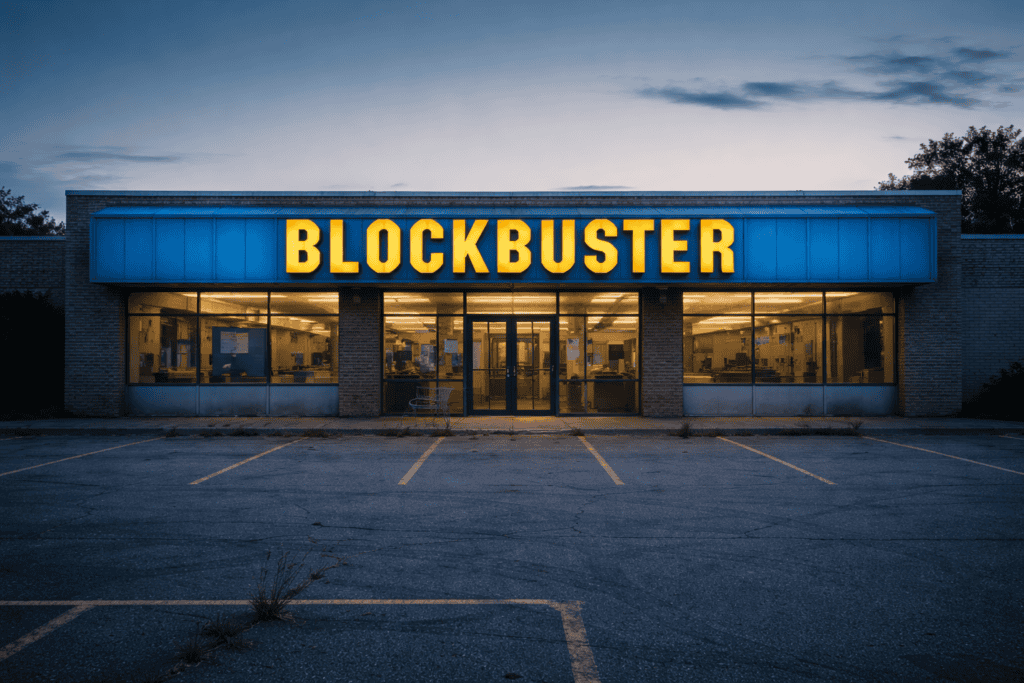
A decade later, Blockbuster went bankrupt as Netflix (and emerging streaming technology) stole its customers and rendered the video rental model obsolete.

This case is a classic cautionary tale of a market leader’s failure to innovate and put customers first, and it holds enduring lessons for modern marketers navigating disruption.

Company Involved

The brand at the center is Blockbuster. For years, Blockbuster was synonymous with home movie rental, operating thousands of video stores worldwide at its peak. Its story intersects with Netflix, the then-fledgling competitor that Blockbuster once had a chance to acquire – a chance that, in hindsight, could have changed the course of media history.

Marketing Topic

Strategy: business model innovation and failure to adapt.
Digital Disruption: technological change overturning an industry.
Customer Experience: convenience and removing friction like late fees.

Public Reaction or Consequences

Initially, many consumers remained loyal to Blockbuster, but frustration was growing. Late fees were a huge pain point – Blockbuster made $800 million a year from late fees around 2000, but that policy bred customer resentment. Netflix capitalized on this by offering no late fees and easy-by-mail rentals, winning praise from movie lovers who were tired of punitive charges. In response, Blockbuster launched a heavily advertised “No More Late Fees” campaign in 2005, but the fine print revealed sneaky fees (like restocking charges) that led to public backlash and legal action from 47 state attorneys general. The media lampooned Blockbuster’s half-hearted changes, and consumers increasingly saw the brand as out-of-touch. By the time Blockbuster filed for bankruptcy in 2010, the public narrative was clear: the once-dominant giant had failed to give people what they wanted – and paid dearly for it.

Why It Matters Today

Disruption can hit any industry: Blockbuster’s downfall shows how quickly digital innovation can upend market leaders, a warning that echoes today amid AI and other emerging tech upheavals.

Customer-centric innovation wins: The case highlights the importance of removing friction and focusing on customer experience (Netflix’s no-fee, on-demand model) in building loyalty.

Adapt or perish: In a fast-changing landscape, even big brands must continually reinvent their strategy. Blockbuster’s fate underscores that clinging to old models instead of disrupting yourself is a recipe for irrelevance.

3 Takeaways

1. Never stop innovating in the face of change. If you don’t disrupt your own business model, a competitor will – as Blockbuster learned the hard way.

2. Put customer experience over short-term profit. Profiting from customer pain points (like late fees) breeds backlash and opens the door for friendlier alternatives.

3. Don’t underestimate new competitors or channels. Dismissing emerging trends (online rentals, streaming) as “hype” can blind you to shifting consumer expectations and cost you your crown.

Notable Quotes and Data

John Antioco (Blockbuster CEO, 2000): Netflix was a “niche business” and “the dot-com hysteria is completely overblown.” (explaining his rejection of a Netflix buyout)

Marc Randolph (Netflix cofounder): “If you are unwilling to disrupt yourself… someone else will disrupt your business for you.”

$800 million in late fees (2000): the annual revenue Blockbuster earned from late charges, at the cost of massive customer frustration.

Full Case Narrative

In the 1990s, Blockbuster was an entertainment powerhouse. The chain had a ubiquitous presence – at its peak in 2004, Blockbuster ran over 9,000 stores worldwide, with $6 billion in annual revenue. Renting movies was a weekly ritual for many families, and Blockbuster enjoyed near-monopoly status in the home video market. However, by the end of that decade, storm clouds were gathering in the form of new technology and shifting consumer habits.

Netflix’s Emergence: In 1997, a small startup called Netflix began offering DVD rentals by mail. Netflix’s founders, Reed Hastings and Marc Randolph, pitched their model as a convenient alternative to driving to a store – a way to get movies without late fees or hassles. Initially, Netflix was very niche: early adopters of DVD players and cinephiles willing to wait for discs by mail. By 2000, Netflix was still unprofitable and relatively small, but it was growing. That year, Hastings and Randolph approached Blockbuster about a buyout. Famously, they offered to sell Netflix to Blockbuster for just $50 million – essentially inviting Blockbuster to absorb their online rental service and run it while Netflix would handle the digital side. Blockbuster’s CEO at the time, John Antioco, laughed off the idea. He and his team saw Netflix as an insignificant player and felt DVD-by-mail was no real threat to their lucrative storefront business. Antioco’s stance was summed up by his remark that “dot-com hysteria” was overblown hype. With the dot-com bubble bursting in 2000, this dismissive attitude wasn’t entirely crazy – but it was short-sighted. Blockbuster declined the offer, leaving Netflix to forge ahead on its own.

The Missed Opportunity: Blockbuster’s decision not to buy Netflix has become legendary in business circles – a what-if scenario as iconic as any. At the time, Blockbuster was a giant and Netflix a minnow. Blockbuster’s confidence bordered on complacency. It’s worth noting that even Netflix’s founders didn’t fully realize how big their idea would become; they themselves had set a relatively low price on their company. Yet, they understood something fundamental that Blockbuster didn’t: customers hated late fees and loved convenience. Netflix’s subscription model (one monthly fee for unlimited rentals, no due dates or late fees) directly attacked Blockbuster’s biggest pain point. In 2000 alone, Blockbuster earned around $800M from late fees, but that revenue came at the cost of customer goodwill. By refusing to adapt their model (or buy a competitor that had), Blockbuster essentially handed Netflix a golden opportunity.

Blockbuster Strikes Back (Too Little, Too Late): As Netflix gained traction through the early 2000s, Blockbuster eventually realized this wasn’t just a fad. In 2004, Blockbuster launched an online DVD subscription service to compete with Netflix, and later a hybrid online-and-store program called “Total Access.” They even started advertising “No More Late Fees” in 2005, acknowledging the negative sentiment late fees caused. However, these moves were either half-hearted or costly missteps. The “No Late Fees” campaign became a PR fiasco – it turned out Blockbuster would still charge customers if they kept a movie more than a week or so (by selling the movie to them and charging a restocking fee on return). This fine print felt like a bait-and-switch. Dozens of state Attorneys General pounced, investigating the advertising as deceptive. Blockbuster ended up settling with 47 states and paying fines to cover refunds. The incident not only hurt Blockbuster’s reputation, but also underscored an important difference in philosophy: Netflix built goodwill by eliminating late fees entirely, while Blockbuster couldn’t quite let go of that crutch.

Around the same time, Blockbuster’s internal strategy was in turmoil. The company’s leadership and shareholders were divided on how aggressively to pursue the new online model. Blockbuster’s CEO John Antioco did push for the online platform and the end of late fees, recognizing the need to change. But these changes cut into short-term profits, upsetting shareholders. Activist investor Carl Icahn led a revolt over Antioco’s spending on new initiatives and what he viewed as the CEO’s high compensation. The conflict led to Antioco’s departure in 2007. The new CEO, James Keyes (formerly of 7-Eleven), took a much more cautious approach. Keyes believed Blockbuster’s strength was its physical presence and that many customers still preferred in-store browsing. In one interview, he even expressed skepticism about streaming and digital on-demand video, comparing it to people still preferring bookstores for new releases. Under Keyes, Blockbuster scaled back its aggressive online efforts – effectively relinquishing the nascent online rental war to Netflix.

The Netflix Ascendancy: Meanwhile, Netflix kept innovating. In 2007, Netflix introduced video streaming for subscribers, just as broadband internet was becoming common. This move proved prophetic: while still offering DVDs, Netflix prepared for a future beyond physical discs. Blockbuster, on the other hand, was hamstrung by its brick-and-mortar legacy. It did make a foray into streaming by acquiring a small service (Movielink) in 2007, but by then Netflix’s brand and user base were far ahead. Redbox kiosks also entered the scene, undercutting Blockbuster’s rentals with $1-a-night DVD vending machines. Blockbuster’s massive store network – once an advantage – became a liability as foot traffic declined. The company had long-term leases and high overhead costs that Netflix and Redbox didn’t bear.

By 2010, the situation was dire. Blockbuster’s revenue was plummeting and the company was burdened with nearly $1 billion in debt. Stores were closing by the hundreds. That year, Blockbuster’s stock was delisted from the NYSE, and in September 2010 the company filed for Chapter 11 bankruptcy protection. It was an astonishing fall for a company that just a few years prior had been on top. In the bankruptcy auction, a winning bid of $320 million from Dish Network bought Blockbuster’s remaining assets in 2011 – a tiny fraction of Blockbuster’s former multibillion-dollar valuation.

Reflection – Why Blockbuster Failed: There are many reasons often cited for Blockbuster’s demise. Some say it was simply outdated technology meeting new tech (VHS and DVD rentals giving way to streaming). Others point to mismanagement and missed opportunities. In truth, it was a combination. Blockbuster failed to anticipate how quickly consumer preferences were changing. The convenience and simplicity offered by Netflix’s subscription model addressed unmet customer needs (no due dates, no driving to the store, personalized recommendations online). Blockbuster did too little, too late to counter that. Strategically, Blockbuster was wed to a business model – retail storefronts – that had been hugely profitable, and it hesitated to disrupt that cash cow. Ironically, Netflix’s founders initially wanted to partner with Blockbuster to combine the best of both worlds (online + stores). Blockbuster’s rejection of that idea, and later half-measures, meant that Netflix eventually beat Blockbuster at both convenience and content delivery.

Crucially, Blockbuster’s marketing and branding strength (everyone knew the name and their blue-and-yellow tickets) couldn’t save it when the value proposition no longer appealed. All the Super Bowl ads and slogans (“Make it a Blockbuster Night!”) weren’t enough to overcome the fact that Netflix offered a fundamentally better customer experience. This case underscores that effective marketing isn’t just about campaigns – it’s about aligning to what customers want and where the market is headed. Blockbuster’s story has become a parable in business schools and marketing circles about the perils of complacency.

Timeline

1985: Blockbuster is founded and quickly grows into a video rental titan through the 1990s.

2000: Netflix offers to sell itself to Blockbuster for $50 million; Blockbuster’s CEO rejects the deal, viewing Netflix’s online model as trivial.

2004: Blockbuster reaches its peak with 9,100 stores and $6 billion in revenue worldwide. The company launches an online DVD rental service to compete with Netflix.

2005: Blockbuster advertises “No More Late Fees.” The campaign backfires when fine print reveals hidden fees; 47 states take legal action, forcing Blockbuster to modify ads and refund customers.

2007: Netflix introduces streaming video for subscribers, accelerating the shift to online viewing. Blockbuster’s longtime CEO John Antioco resigns under investor pressure; James Keyes becomes CEO and emphasizes store-based strategy while downplaying the threat of streaming.

2010: With revenue in freefall and nearly $1 billion in debt, Blockbuster files for bankruptcy protection. Its store count drops rapidly as outlets close nationwide.

2011: Dish Network acquires Blockbuster out of bankruptcy for $320 million and attempts to integrate the brand into its services. Blockbuster’s remaining company-owned stores continue to shut down.

2019: The once-mighty chain is reduced to a single independent Blockbuster store (in Bend, Oregon) still operating as a nostalgic holdout – the last relic of an era.

What Happened Next?

After bankruptcy, Blockbuster never recovered as a national brand. Dish Network initially kept about 1,700 stores open and experimented with using the Blockbuster brand for on-demand video, but these efforts fizzled amid heavy competition. By 2014, Dish had closed all remaining corporate-owned Blockbuster stores. The last store in Bend, Oregon – a locally franchised outlet – survived by embracing nostalgia and community support (it even became the subject of a 2020 Netflix documentary about itself). Blockbuster’s marketing today is essentially nonexistent, aside from occasional social media nostalgia posts and the odd “remember when?” viral content. In 2023, a cryptic revival buzz sparked when Blockbuster’s website briefly went live again, but as of now no real comeback has materialized.

On the flip side, Netflix grew into a streaming behemoth with hundreds of millions of subscribers worldwide, and it now produces award-winning original content. Netflix’s marketing emphasizes innovation and personalization – the very values Blockbuster had struggled to adopt. The contrast between the two companies’ trajectories couldn’t be more stark. For modern marketers, Blockbuster’s demise remains a vivid reminder that even legendary brands can vanish if they fail to keep up with consumer trends and tech disruption.

One Sentence Takeaway

Even a dominant market leader can fall when it stops innovating and ignores evolving customer needs – Blockbuster’s fate is a lesson to never grow complacent.

Sources and Citations

Fortune: Blockbuster “laughed us out of the room,” recalls Netflix cofounder on trying to sell company for $50 million

Vanity Fair: He “Was Struggling Not to Laugh”: Inside Netflix’s Crazy, Doomed Meeting With Blockbuster

U.S. Securities and Exchange Commission: Blockbuster Form 10-K with store count table showing total stores as of December 31, 2004

Los Angeles Times: Blockbuster Settles State Probes Into Late-Fee Ads

California Department of Justice: Attorney General announces settlement with Blockbuster over “No Late Fees” advertising

The Guardian: Blockbuster files for Chapter 11 protection

Reuters: Dish expands its scope with Blockbuster win

Reuters: Dish Network to close all Blockbuster stores, lay off 2800

TIME: “It’s Just Us Left.” Meet the Manager Running the World’s Last Blockbuster

Case Study: Blockbuster’s Demise and the Missed Opportunity to Buy Netflix Read More »

case study morton thiokol o ring

Case Study: Morton Thiokol and the Data Failures Behind the Challenger Disaster

Reading Time: 6 minutes

Brief Summary

The Space Shuttle Challenger explosion in 1986 stands as a stark lesson in how ignoring critical data can lead to catastrophe.

Engineers had warned that the shuttle’s O-ring seals could fail in cold weather, but their concerns were downplayed amid pressure to launch.

The result was a tragic failure broadcast live to millions. This case highlights how data oversight and organizational bias contributed to disaster – a story that carries powerful warnings for today’s data-driven marketers about heeding evidence and managing risk.

Company Involved

NASA (National Aeronautics and Space Administration) – the U.S. space agency behind the Space Shuttle program – is at the center of this story, along with its booster contractor Morton Thiokol. NASA’s official site outlines its mission in space exploration, but the Challenger incident became one of its darkest moments.

Marketing Topic

  • Data ethics
  • Strategy
  • Crisis response

Public Reaction or Consequences

The Challenger disaster played out in front of a national audience and quickly became a defining moment of public grief and anger. As the investigation unfolded, the story shifted from “accident” to “preventable failure,” which damaged NASA’s credibility and created a long-term trust problem that required years of operational reform and public transparency to rebuild. The consequences extended beyond reputation: shuttle flights paused for an extended period, leadership and governance were scrutinized, and the program’s decision-making culture became a permanent cautionary tale.

Why It Matters Today

  1. Many marketing teams now operate inside dashboards, attribution systems, and AI outputs that can create false confidence when the data is incomplete, biased, or framed to support a preferred outcome.
  2. Modern marketing has plenty of incentives to ship: campaign calendars, quarterly targets, product launches, investor expectations, and the fear of missing the moment. These pressures can quietly encourage data cherry-picking.
  3. Visuals and reporting formats can hide risk just as easily as they reveal it: the wrong chart, the wrong grouping, or the wrong omission can mislead decision-makers without anyone intending harm.
  4. When something goes wrong, the public story becomes about trust: who knew what, when they knew it, and why action did not match the warning signs. That dynamic applies to privacy issues, safety issues, misleading claims, and brand crises.

3 Takeaways

  1. Treat data as a decision test, not a decision defense: if you only look for confirming signals, you will miss the warnings that matter most.
  2. Make risk legible: when the downside is severe, the burden is on the team presenting the data to communicate clearly, directly, and in a format that decision-makers cannot misunderstand.
  3. Pressure is not proof: urgency, schedule demands, and stakeholder expectations are not evidence. If the data is uncertain or trending the wrong way, the responsible move is to slow down, validate, and re-evaluate.

Notable Quotes and Data

  1. A widely cited line from the Rogers Commission materials summarizes the core lesson: reality will not conform to messaging when physics, risk, or constraints are ignored.
  2. A key finding from the investigation emphasized that temperature and O-ring performance were linked, and that the relationship could be seen in prior flight history if analyzed carefully.
  3. The disaster occurred 73 seconds after liftoff, which made the event both sudden and unmistakably public, intensifying the reputational consequences for NASA and its contractors.

Full Case Narrative

The Space Shuttle program operated under extreme complexity, high public visibility, and constant schedule pressure. In that environment, organizations often default to what feels safe: relying on precedent, accepting anomalies that did not yet create catastrophe, and assuming that a successful past outcome is evidence of future safety.

What Made This a Data Ethics Failure

This case is often framed as a leadership failure, but the more precise lesson is how an organization can become ethically careless with data without intending to be dishonest. The failure was not a lack of data collection. It was a failure of how data was framed, challenged, and communicated when the stakes demanded extreme clarity.

  1. Data framing failure: The information was not organized in a way that made the core risk unmistakable. When the key variable is not made visually and analytically dominant, decision-makers can walk away believing the risk is unclear even when patterns exist.
  2. Confirmation bias: Success in prior launches encouraged optimistic interpretation. Ambiguous signals were treated as reassurance instead of a reason to slow down and investigate, which is a common failure pattern in organizations that assume past success is proof of future safety.
  3. Normalization of deviance: Repeated near-misses reduced the perceived seriousness of warning signs. When abnormal outcomes do not immediately trigger catastrophe, the organization gradually treats them as acceptable, which shifts the ethical threshold for what is considered safe enough.
  4. Organizational pressure and authority gradient: Schedule pressure and hierarchy affected how evidence was weighed. When experts feel constrained in how forcefully they can present risk, and when decision-makers demand certainty before acting, the process quietly rewards minimization rather than caution.

For modern marketers, this is the core takeaway: data ethics is not only about whether numbers are true. It is also about whether uncertainty is disclosed, whether inconvenient signals are surfaced, and whether the decision process is designed to reveal risk rather than rationalize momentum.

In the lead-up to Challenger’s launch, engineers had observed O-ring erosion and joint performance issues on prior missions. The concern was straightforward: the O-rings needed to seal quickly and reliably, and cold temperatures could reduce their ability to respond as designed. The risk was not theoretical. It was rooted in observed performance and the mechanics of how the joint sealed.

The night before launch, a decision meeting evaluated whether conditions were acceptable. One of the most cited problems from later analysis was not simply that decision-makers reached the wrong conclusion, but that the information presented did not force the right question. Data was discussed in ways that diluted the central variable, temperature, and reduced the decision to an argument rather than an analysis. The format of the evidence, what was included, and what was left out contributed to uncertainty at exactly the moment clarity was required.

This is the part marketers should pay attention to: the failure was not a lack of data collection. It was a failure of data framing, data completeness, and data communication under pressure. When decision-makers are rushed, they rely heavily on what the data presentation makes obvious. If the presentation hides the real pattern, the organization can walk into a preventable crisis while still believing it is being “data-driven.”

Challenger launched in unusually cold conditions. Seventy-three seconds after liftoff, the shuttle broke apart, and seven lives were lost. The public impact was immediate, but the long-term impact came from what the investigation revealed about organizational behavior. The tragedy became evidence that repeated near-misses can normalize risk, that internal warnings can be softened by hierarchy and urgency, and that flawed presentations can make danger look like noise.

For modern marketing, the direct translation is not about rockets. It is about how organizations treat signals. A brand can ignore early indicators of customer harm, privacy violations, misleading claims, unsafe product behavior, or runaway algorithmic outcomes. The numbers might be present somewhere in the reporting stack, but if they are not surfaced correctly, they will not change decisions.

The Challenger case also shows why ethics belongs inside analytics. When the downside is severe, the standard cannot be “we did not have definitive proof.” The standard has to be “we recognized risk, we acknowledged uncertainty, and we acted responsibly before the damage became irreversible.” That is as true for consumer trust as it is for engineering safety.

Timeline

  1. 1985: Concerns about O-ring erosion and joint behavior are formally documented within contractor channels.
  2. January 27, 1986: A decision meeting reviews risk in light of cold temperatures, and the launch is approved.
  3. January 28, 1986: Challenger breaks apart 73 seconds after liftoff.
  4. June 1986: The Rogers Commission releases findings on technical causes and decision-making failures.
  5. 1988: Shuttle flights resume after redesigns and organizational reforms.

What Happened Next?

NASA paused the shuttle program, redesigned key joint components, and implemented procedural changes intended to strengthen safety and decision governance. The agency also faced a long credibility recovery, because the public narrative was no longer about ambition or innovation, but about whether leadership could be trusted to weigh evidence honestly. Over time, Challenger became embedded in training, management literature, and risk culture discussions as a warning about normalization, pressure, and the difference between reporting data and understanding it.

For marketers, the lasting lesson is that trust is slow to build and quick to lose. When a crisis is linked to ignored warnings, the reputational harm expands beyond the initial event. It becomes a story about values, responsibility, and whether leadership deserves confidence.

One Sentence Takeaway

Data cannot protect a decision if the organization only uses it to justify moving forward.

Sources and Citations

NASA: Report of the Presidential Commission on the Space Shuttle Challenger Accident (Rogers Commission) index

NASA: Rogers Commission Report, Volume 2, Appendix F (Richard Feynman)

National Archives DocTeach: Memo from R. M. Boisjoly to R. K. Lund on O-ring erosion (July 31, 1985)

NASA Safety Center: Normalization of Deviance safety message (PDF)

Edward Tufte: Visual and Statistical Thinking, displays of evidence and the Challenger launch decision (PDF)

University of Chicago Press: The Challenger Launch Decision by Diane Vaughan (overview)

Case Study: Morton Thiokol and the Data Failures Behind the Challenger Disaster Read More »

case study got milk campaign

Case Study: Got Milk? When Awareness Does Not Equal Consumption

Reading Time: 11 minutes

Brief Summary

In the early 1990s, America’s dairy industry faced declining milk consumption despite decades of “good for you” advertising.

Enter “Got Milk?”, a 1993 ad campaign that flipped the script by humorously highlighting life without milk. The catchy Got Milk? slogan and milk-mustached celebrities became pop culture sensations, driving 90% awareness in California within two years.

However, while the campaign won awards and imitation everywhere, its impact on actually getting people to drink more milk was limited.

This case study explores how Got Milk? became a marketing phenomenon, what results it delivered (including a short-term sales bump), and what modern marketers can learn from its creative wins and strategic missteps.

Company Involved

The campaign was led by the California Milk Processor Board (CMPB), a state dairy trade group. They partnered with advertising agency Goodby, Silverstein and Partners to create Got Milk?. Later, the national Milk Processor Education Program (MilkPEP) adopted the slogan for nationwide use, extending the campaign’s reach.

Marketing Topic

  • Advertising
  • Branding
  • Consumer Behavior

Public Reaction or Consequences

The public’s reaction to Got Milk? was overwhelmingly positive. The ads struck a chord by humorously depicting people stuck with cookies or cereal and no milk, a “deprivation” strategy instantly relatable to millions. The 1993 “Aaron Burr” TV spot became an award-winning hit, and within months “Got Milk?” entered the cultural lexicon. By the mid-90s, 91% of U.S. adults recognized the campaign. The slogan spawned countless parodies (“Got [Anything]?”) and merchandise. Mattel even released a special-edition Got Milk? Barbie in 1995, reflecting how the campaign turned a humble beverage into a pop culture icon.

However, popularity didn’t immunize Got Milk? from criticism or unintended consequences. The California Milk Board occasionally pushed the edgy humor too far. In 2011, a spin-off campaign suggesting milk could relieve PMS symptoms (taglined “Everything I do is wrong”) backfired badly. It featured hapless men offering milk to irritable women and was widely slammed as sexist. The public outcry forced the ads to be pulled within weeks, and the Board issued apologies on a “Got Discussion?” site. Additionally, animal-rights groups like PETA lampooned Got Milk? with guerrilla spoofs (e.g. “Got Pus?”) to protest dairy, prompting CMPB to threaten legal action. These episodes showed that even beloved campaigns can misstep and face backlash when messaging misses the mark.

Most notably, despite Got Milk?’s fame, Americans didn’t significantly increase their milk intake in the long run. The campaign coincided with powerful shifts in consumer habits. The rise of soft drinks, juices, and later almond and oat milks cut into milk’s market. Through the 1990s and 2000s, per-capita milk consumption continued a decades-long slide. This disconnect between ad recognition and behavior ultimately led the industry to rethink its strategy.

Why It Matters Today

  • Power vs. Limits of Branding: Got Milk? proves a campaign can achieve viral cultural status and still struggle to change consumer behavior. Modern marketers must balance creative branding with strategies that drive actual usage or sales, especially when facing broader lifestyle trends.

  • Adapting to Consumer Trends: This case highlights the need to pivot messaging as consumer preferences evolve. Dairy promoters eventually shifted from whimsical deprivation ads to nutrition-focused appeals (the 2014 “Milk Life” protein campaign) and even TikTok challenges in 2020. Effective marketing today demands agility and awareness of health trends, social media, and new consumer values.

  • Brand Equity and Beyond: Got Milk? shows how a great slogan can transcend its original campaign. The tagline became a licensable asset, featured on Oreos, Barbies, and t-shirts, generating over $10 million in licensing revenue for the milk board. Marketers can learn to leverage intellectual property and partnerships to extend a campaign’s life and impact.

3 Takeaways

  1. An Iconic Slogan Isn’t a Strategy: Catchy slogans and funny ads alone won’t guarantee sustained sales. Marketing must connect to product consumption (in this case, getting people to actually drink milk), not just win attention. Always tie campaign success metrics to real behavior change, not just awareness.

  2. Adapt or Lose Relevance: Even legendary campaigns must evolve. Got Milk? thrived when it tapped cultural moments and consumer insights, but it faltered when it failed to address changing diets and attitudes. Marketers should continually monitor trends (health, convenience, social media) and update their messaging to stay relevant.

  3. Build a Brand, Not Just an Ad: Got Milk? turned a commodity into a cultural talking point and even a brand in its own right. By co-branding with food partners and merchandising the slogan, the campaign added value beyond ads. The lesson: great marketing can create enduring brand assets, but those assets work best when leveraged alongside product innovation and customer experience improvements.

Notable Quotes and Data

  • “First sales increase in 10+ years:” In 1994, California’s milk sales increased for the first time in over a decade, reaching 755 million gallons sold (up from 740 million in 1993). The Got Milk? launch is credited with halting what had been a steady decline in milk demand.

  • Cultural saturation: By the mid-1990s, 91% of U.S. adults were familiar with the Got Milk? campaign, an astonishing level of awareness for a commodity product. More than 300 celebrities, from supermodels to cartoon characters, eventually donned the famous milk mustache in ads.

  • Consumption kept falling: “Got Milk?” didn’t actually get people to buy more milk. Per-capita milk consumption dropped from about 0.96 cups per day in 1970 to 0.59 cups by 2011. The ads were popular, but Americans kept reaching for soda, juice, and later soy and almond milk alternatives for various lifestyle reasons.

Full Case Narrative

Background: By 1993, milk was in crisis. For decades, U.S. dairy producers had poured money into generic “milk is good for you” advertising, only to watch consumers drift to Coca-Cola, Snapple, sports drinks and other beverages. In California, the nation’s #1 dairy state, per-capita milk consumption had plummeted from 29 gallons a year in 1980 to 23 gallons by 1993. Annual milk sales were declining 3 to 4% and the usual health-based ads weren’t working. The newly formed California Milk Processor Board (a consortium of dairy processors) realized they needed a bold new approach or risk “losing the farm.” Their goal was simple but daunting: stop the bleeding and get people drinking milk again.

The Big Idea: CMPB hired Jeff Manning as executive director and tapped Goodby, Silverstein and Partners, a creative San Francisco ad agency, to reimagine milk marketing. Through research, the team uncovered a key insight: nearly everyone already believed milk was healthy. The problem was they still weren’t drinking more. They noticed that milk is almost always consumed with foods (cereal, cookies, peanut butter and jelly), and people only really crave milk when they run out at the worst time. This led to the “milk deprivation” strategy: instead of extolling milk’s virtues, dramatize how awful life is without it.

The agency brainstormed a simple, cheeky question to capture that feeling: “Got Milk?”. In October 1993, the first Got Milk? TV commercial, “Aaron Burr,” aired in California. Directed by a young Michael Bay, the ad showed a history buff failing to answer a $10,000 trivia question on-air because a mouthful of peanut butter made him choke out “Aaron Burr” unintelligibly, and he has no milk to wash it down. The absurd humor and cinematic flair grabbed viewers’ attention. Got Milk? had entered the chat.

Marketing Blitz: The Aaron Burr ad was an instant hit, winning a Clio Award and rave reviews in early 1994. Building on that momentum, CMPB rolled out a blitz of “deprivation” scenarios in TV and print. One memorably dark-humored spot (“Heaven”) showed a man in a cookie-laden heaven that turns out to be hell because all the milk cartons are empty. Another parodied Citizen Kane with a tycoon desperately searching for an Oreo dunked in milk. Every ad ended with that stark “Got Milk?” on screen. Meanwhile, print ads simply showed enticing foods (cookies, cake, cereal) minus milk, letting viewers feel the thirst.

The Got Milk? team also measured everything. They set aside the usual “attitude awareness” surveys and instead tracked actual milk usage in thousands of households. By 1995, the data was promising: awareness of Got Milk? hit 90% in California, household milk-buying rates stopped falling, and people reported using milk more frequently. Indeed, 1994 milk sales ticked up in California for the first time in over ten years. The campaign appeared to be delivering on its objective of stabilizing demand, at least regionally.

Beyond sales, Got Milk? achieved marketing nirvana: it became cool. The slogan went viral (pre-social media) purely via news and word-of-mouth. Newspapers and TV shows talked about the clever ads. “Got milk?” turned into a catchphrase used and abused by anyone with something to sell, from bumper stickers to t-shirts. The California Milk Processor Board shrewdly capitalized on the craze by licensing the tagline. Starting in 1995, the national MilkPEP program put “Got Milk?” on its famous milk mustache print ads, recruiting over 300 celebrities (actors, athletes, even Kermit the Frog) to pose with milk moustaches in magazines. CMPB also cut licensing deals with food companies. Nabisco printed “Got Milk?” on Oreo packages, Nestlé put it on Nesquik bottles, and even Barbie dolls sported mini milk cartons with the slogan. By turning the campaign into a licensing brand, the milk board generated millions in extra revenue and kept Got Milk? in the public eye.

Results – Did It Work?: In terms of branding and buzz, Got Milk? was a grand-slam. It ran for over 20 years (1993 to 2014) and nabbed almost every advertising award in existence. The campaign is taught in marketing textbooks as an example of genius positioning, how a simple question made a mundane product culturally relevant. Importantly, Got Milk? did achieve its short-term goal in California: it stopped a freefall in milk sales. The first year, sales volume actually rose about 2%. Over the next several years, the decline in per-capita milk consumption flattened in California, saving an estimated $255 million in potential losses annually that might have occurred without the campaign. Jeff Manning referred to Got Milk? as “the Godfather” of marketing campaigns, one that “helped turn around milk sales” when it mattered.

Nationally, the picture was murkier. Got Milk? certainly boosted milk’s mindshare, by 1996, over 90% of Americans recognized the ads, and many states adopted the slogan through their dairy boards. Yet, actual U.S. milk consumption kept slipping in the long run. From the 1970s to 2010s, Americans steadily drank less milk each decade, due to diversifying beverage choices, rising concerns about calories, and changing breakfast habits. By one measure, per-capita milk intake fell about 25% from 1975 to 2012, despite two decades of Got Milk? advertising. Milk simply had entrenched challenges that witty ads alone couldn’t overcome: competition from colas and later energy drinks, the advent of bottled water and coffee chains, even the decline of breakfast cereal as people grabbed quicker options. In the 2000s, concerns about lactose intolerance and the rise of plant-based milks (soy, almond) further eroded milk’s edge. Thus, while Got Milk? prevented a sharper drop and gave milk a “cool factor” it never had, it ultimately could not reverse the long-term decline in consumption nationwide. As marketing analyst Kirk Kardashian quipped, “Got Milk? didn’t actually get people to buy more milk” in the end.

Keeping It Fresh: To its credit, the Got Milk? campaign continually evolved creatively. By the late ’90s, Goodby Silverstein worried the joke might wear thin if every ad was a predictable “out of milk” gag. They refreshed the approach with new angles. For example, a series set in a dystopian “Town Without Milk” (1997) imagined a bleak world where milk’s absence causes despair. They also targeted younger audiences, producing edgy teen-oriented spots. These ads tested well and kept the campaign feeling inventive. The team embraced co-branding as well. Milk ads started featuring cameos from Oreo cookies, cereal mascots, and even the Sesame Street Cookie Monster, emphasizing milk’s partners in crime. This partnership strategy was ahead of its time. It acknowledged that milk’s best hope was to hitch itself to foods people loved, rather than pretend people would chug plain milk for its own sake. The California board also smartly invested in multicultural marketing. Recognizing that Hispanic families were heavy milk consumers but didn’t relate to the quirky “Got Milk?” humor, they developed Spanish-language campaigns focusing on family and recipes (under slogans like “Familia, Amor y Leche”), which earned praise and bolstered milk usage in those communities.

Not every idea succeeded. Aside from the infamous 2011 PMS campaign debacle, another controversial moment came in 2005 when a Got Milk? ad parodying steroid use in baseball (implying a player’s secret strength was milk) upset Major League Baseball officials. But by and large, Got Milk? maintained a positive image and demonstrated remarkable longevity for a marketing campaign.

Transition – The End of “Got Milk?”: By 2013, after 20 years, milk consumption was still trending down and some in the industry felt Got Milk?, however clever, had run its course. Dairy farmers had actually stopped contributing to the national ad budget years prior, preferring to fund product innovations and partnerships (like putting milk in McDonald’s Happy Meals) that they felt had more direct impact. In early 2014, MilkPEP made a bold move: they retired “Got Milk?” as the national slogan, replacing it with a new campaign called “Milk Life”. The Milk Life ads emphasized milk’s protein and nutrients, showing everyday people powered by milk in energetic scenarios. This shift acknowledged a new reality. Consumers wanted functional benefits (protein for breakfast, etc.), and the milk industry needed to remind them of milk’s nutritional value to compete with protein shakes and plant milks. California, however, held onto Got Milk? for its local marketing, believing the brand equity was too strong to abandon. The original slogan remained active on the West Coast even as “Milk Life” took over nationwide.

Timeline

  • 1993 (Oct): “Got Milk?” campaign launches in California with the famous Aaron Burr TV commercial. The tagline immediately resonates with consumers.

  • 1994: Milk sales in California rise for the first time in over 10 years (up to 755 million gallons from 740 million in ’93). The campaign wins top advertising awards and becomes a pop culture phenomenon.

  • 1995: MilkPEP licenses Got Milk? for a national milk mustache ad campaign. Celebrities from supermodels to athletes pose with milk mustaches in print ads, all bearing the “got milk?” logo. Got Milk? Barbie doll debuts, and the slogan is licensed for use on Oreo cookies and other products.

  • 1997: Amid concerns of ad wear-out, the campaign tests new creative directions (e.g. the surreal “Town Without Milk” series) to keep consumers engaged. By now, Got Milk? is used by dairy boards across the U.S. via licensing.

  • 2011: CMPB’s “Everything I do is wrong” PMS-themed ads spark a public backlash over sexist messaging. Within two weeks, the campaign is pulled and replaced with an apology website. This PR crisis shows the risks of straying off-tone.

  • 2014: National retirement of Got Milk? – MilkPEP unveils the new “Milk Life” campaign focusing on protein and nutrition. The era of whimsical deprivation ads ends as the industry tries a more straightforward pitch to boost sales. California continues with Got Milk? locally.

  • 2020: Got Milk? is resurrected by MilkPEP during the COVID-19 pandemic, as home-bound consumers bought more milk. A modern twist: the #GotMilkChallenge on TikTok invites users to show off tricks with milk, generating over 430 million views. The slogan is reintroduced to a new generation via social media and influencer content.

What Happened Next?

After pivoting to Milk Life, the dairy industry saw only modest impacts. Milk’s decline slowed but not dramatically reversed. The new ads reminded consumers that milk has 8g of protein per glass, aligning with the high-protein diet trend. Yet, competition from dairy-free alternatives intensified through the late 2010s. The conversation around health also shifted. Concerns about sugar (in flavored milks), animal welfare, and lactose intolerance grew louder, posing challenges that pure marketing couldn’t fix overnight.

By 2020, a surprising uptick in milk demand (thanks to pandemic stockpiling and more breakfasts at home) gave dairy marketers an opening. Seizing the moment, MilkPEP brought back “Got Milk?” for the social media age. The reboot didn’t rely on expensive celebrity magazine spreads, but on viral user-generated videos. One headline stunt featured swimmer Katie Ledecky swimming the length of a pool with a glass of chocolate milk balanced on her head, not spilling a drop. The accompanying #GotMilkChallenge exploded on TikTok, amassing hundreds of millions of views. Everyday people posted milk chugging tricks, mustache selfies, and creative recipes, all hashtagged with the iconic slogan. This campaign within a campaign showed how Got Milk? still had resonance and could be reinvented to spark engagement.

As of today, milk advertising continues to evolve. The dairy industry has embraced strategies beyond traditional ads, from partnering with fast-food chains to put milk in kids’ meals, to developing lactose-free milk and high-protein dairy drinks to meet consumer needs. Got Milk? remains active in California and in periodic national pushes, often with a nostalgic or retro appeal. Meanwhile, plant-based milks use marketing of their own (sometimes playfully riffing on “Got Milk?”, e.g. “Got Oat Milk?” slogans). The legacy of Got Milk? endures as a masterclass in branding, but also as a cautionary tale that even the catchiest slogan can’t single-handedly overcome broad societal shifts.

One Sentence Takeaway

A brilliant ad campaign can turn a product into a cultural icon, but lasting marketing success comes from converting cultural impact into sustained consumer action.

References

Mental Floss – “Udder Success: A Brief History of the ‘Got Milk?’ Campaign”

The New Yorker – “The End of Got Milk?”

ASAE – “Got Milk? Marketing by Association”

The Atlantic – “Milk Is at the Center of Sexist Allegations”

CBS News – “Got Milk” ad campaign ends after 20 years

Case Study: Got Milk? When Awareness Does Not Equal Consumption Read More »

case study brain on drugs

Case Study: This Is Your Brain on Drugs and the Power and Limits of Fear-Based Marketing

Reading Time: 6 minutes

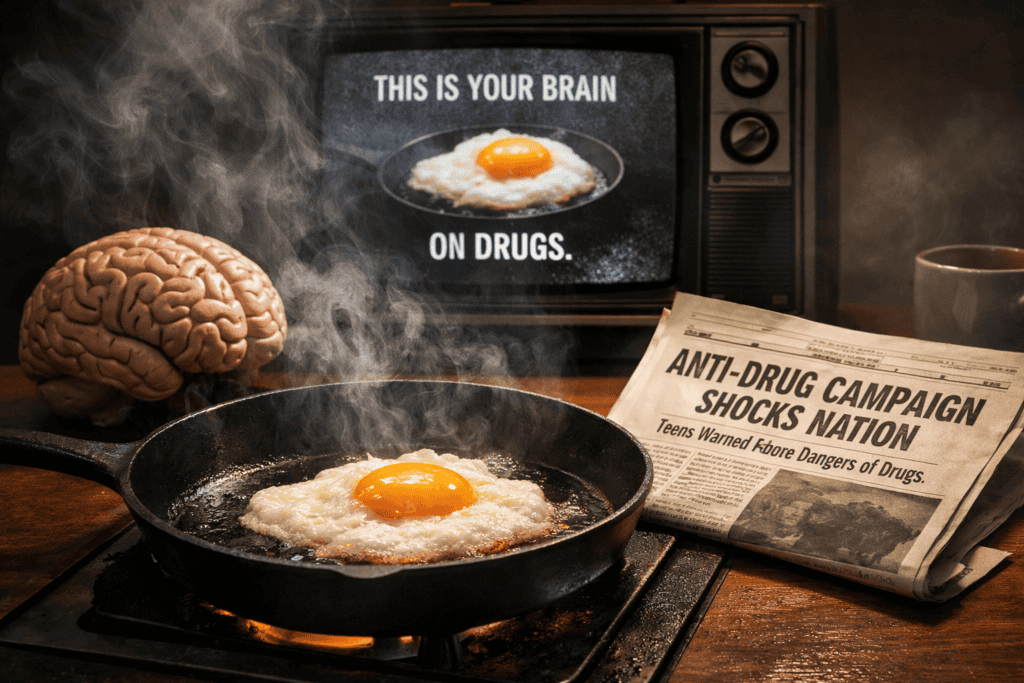
The 1987 PSA “This Is Your Brain on Drugs” (Partnership for a Drug-Free America) became an iconic anti-drug image. It was credited with raising teens’ perception of cocaine risk (from 78% to 88%), but later research found fear-based youth campaigns had little beneficial effect, and in some cases correlated with increased drug use.

The slogan and frying-egg imagery went viral in pop culture (even drawing an Egg Board protest, but experts (and Syracuse professor Robert Thompson) argue it was too “preachy” and may have backfired.

The concept was later updated in 1997 (a heroin-themed spot with Rachael Leigh Cook and 2017 (Cook again, this time condemning the “war on drugs”. Modern analyses suggest marketers today should balance emotional impact with audience research and relevance, learning both from the campaign’s iconic strengths and its shortcomings.

Background: Partnership for a Drug-Free America

Founded in 1986 by advertising and public health leaders (with $300,000 seed funding from the American Association of Advertising Agencies, the Partnership for a Drug-Free America (PDFA) was a nonprofit social-marketing coalition. Its strategy was to “treat [illicit drugs] like any other purchasing choice” – using marketing tactics to “un-sell” drugs rather than sell them. In practice, volunteer agencies created hard-hitting PSAs and donated airtime, aiming to influence teens as if they were consumers. The organization (now renamed the Partnership to End Addiction) applies research-backed tools to prevent youth substance abuse. In short, PDFA pioneered social marketing and public service advertising, applying commercial creativity to a public health cause.

Marketing Categories

  • Social Marketing / Public Service Advertising: The campaign is a classic PSA – no paid media, high-profile creative aimed at social good. It targeted youth with a stark visual metaphor, akin to marketing a product (but with a negative message).
  • Cause Branding / Coalition Marketing: PDFA became a brand. Dozens of big agencies (Saatchi & Saatchi, J. Walter Thompson, etc.) volunteered creative work, giving PDFA an industry gloss. The partnership leveraged celebrity culture (“Liken potential addicts to consumers… by celebrity endorsements…Then use those tricks not to sell the product, but to un-sell it” and claimed ~$1 million/day in donated media (over $2 billion total) to saturate TV and print.
  • Behavior Change Communication: It falls under health promotion campaigns. Its use of fear appeals (making the brain look fried) and repetition was designed to change teen attitudes and norms, following PDFA’s strategy of using “the best ad minds to denormalize drug use”.

The Original 1987 PSA (“Brain on Drugs”)

In 1987 PDFA aired a 30-second spot featuring actor John Roselius cracking an egg into a hot frying pan, declaring: “This is your brain… [sizzle] …This is drugs. This is your brain on drugs. Any questions?”. The simple, graphic metaphor and tagline made it instantly memorable. Paul Keye – a creative director involved – recalls the campaign was born from the ad industry’s eagerness to “un-sell” hard drugs during Nancy Reagan’s “Just Say No” era. Agencies convinced networks to donate airtime; Keye estimates over $300 million worth of free spots were aired. The PSA ran heavily for months. Audience research later claimed ~92% of teens saw it, and 88% reported believing even occasional cocaine use was dangerous (up from 78% before the ads). Dealers allegedly joked “Let’s go fry an egg” to mean using drugs, showing the line’s penetration into youth slang.

Timeline of Key Events

  • 1987: Original “Brain on Drugs” PSA airs nationwide.
  • 1989–90: PDFA continues high-profile anti-drug campaigns; by 1990 the Fried-Egg spot was ranked No. 11 on TV Guide’s Top 50 commercials.
  • 1997: A new “Brain on Drugs” PSA debuts featuring Rachael Leigh Cook; in this spot her character smashes eggs and even a kitchen to dramatize heroin’s ravages.
  • 2016: A third “Brain on Drugs” PSA (without Cook) is released, targeting teens.
  • 2017: Cook stars in a remade PSA (released on 4/20/2017) with a twist: it critiques U.S. drug policy, noting that white users are unlikely to be arrested vs. people of color, and condemning the “war on drugs” as costly and ineffective.
  • 2010s: PDFA rebrands (first as Partnership at DrugFree.org, then Partnership for Drug-Free Kids) and shifts to digital/parent-focused campaigns (e.g. the “Time to Talk” prescription-drug prevention initiative).

Public and Media Response

The Fried-Egg PSA struck a chord. It was widely cited as *“iconic”* in advertising lore (Time called it iconic in a top-10 PSA list and spawned countless parodies on TV, T-shirts, and the Web. Medill News notes it became “one of the most well-recognized… health campaign ads of all time, evoking parodies and drawing the ire of comedians and musicians”. The tagline “Any questions?” became a catchphrase. Even the American Egg Board complained that the ad unfairly linked their product with drugs. Over time, the image became a cultural shorthand: teen slang picked it up (“fry an egg” for using), and comedians joked about it. Critics, however, called it heavy-handed. Some students reported it felt more like a dare than a deterrent, while others said it truly scared them. Syracuse professor Robert Thompson quipped that he’d “ready to go score some cocaine… to spite the commercial… It was so irritatingly preachy and not effective”. In short, the spot was unforgettable, but it polarized audiences.

Effectiveness: What Really Happened?

Positive Indicators: PDFA cited surveys showing increased risk perception. For example, after the ads 88% of teenagers said even occasional cocaine was dangerous, up from 78% before. The campaign achieved enormous reach, and some analyses (like PDFA’s own press and a 1994 Johns Hopkins commentary) claimed it contributed to youth drug-use deterrence.

Critical Findings: Independent research painted a more nuanced picture. A 2008 *American Journal of Public Health* analysis found that, overall, the National Youth Anti-Drug Media Campaign (which included these PSAs) had no positive effect on teens, and in some cases higher exposure predicted *earlier* drug initiation. A Lancet review concluded drug prevention ads generally showed **“little effect”** on substance use (unlike anti-tobacco campaigns). Notably, a study cited by Prevention specialists observed that youths who saw the campaign were actually *more* likely to use drugs later. Qualitative feedback supports this skepticism: one teen said the ad “stirred my curiosity” and called it a dare, while another said it had genuinely scared her. These findings suggest that despite its fame, the PSA’s actual influence on behavior was limited or mixed. As analysts warn, a campaign that isn’t aligned with audience perceptions can even “move [the] target audience away” from desired change.

Relevance Today

For today’s audiences, the original PSA’s approach feels dated. Media consumption is fragmented (social media, streaming), and many young people distrust blunt scare tactics. Neuroscientific research implies that the best health ads are those that combine emotional engagement with clear rationale. For instance, one study found the most persuasive anti-drug PSAs evoked strong emotional brain responses while using *“less yelling”* – meaning they conveyed consequences in a compelling, nuanced way. This suggests modern campaigns should avoid just shouting warnings; they need narrative hooks or real stories. Cultural shifts also matter.

With increasing acceptance of marijuana and criticism of the War on Drugs, an ad showing a frying brain might lack credibility. The 2017 remake reflects current values: instead of scaring viewers, it used the egg to critique systemic injustice (“the war on drugs is ruining lives… it doesn’t work”. This aligns with today’s trend of addressing social context (racial disparity, policy) and health equity. Marketers now often blend digital outreach and peer-based messaging rather than relying solely on TV PSAs.

Finally, experts emphasize combining ads with broader measures: Wakefield’s Lancet review noted health campaigns work best when paired with policies or education (anti-tobacco ads succeeded when governments taxed and banned smoking). In short, the “brain on drugs” ad remains a powerful symbol, but effective drug prevention today requires data-driven, multi-channel strategies that fit modern culture and media.

3 Actionable Marketing Takeaways

  • Use audience research to target messaging: Don’t assume scare tactics work for all groups. Studies warned that a misalignment between the ad’s tone and teens’ own experiences can backfire, even “moving [them] away” from the goal. Test ads with focus groups and be ready to adjust your framing to what resonates with your audience’s knowledge and values.
  • Balance emotion with clarity: Impactful ads do not have to be preachy. A neuroscience-informed study found the most effective anti-drug ads triggered emotional engagement while still being understandable (they were “less yelling, but more compelling”. Aim for storytelling that connects with viewers emotionally but clearly illustrates consequences or solutions. Avoid oversimplification or heavy-handedness that might cause resistance.
  • Adapt to context and culture: Modern campaigns should incorporate current trends and media. For example, the 2017 PSA smartly re-used a classic image to address today’s issues. Similarly, align your message with popular platforms (social media, influencers) and broader initiatives (education programs, policy changes). Remember, combining marketing with systemic support (like in tobacco control) boosts effectiveness.

Single-Sentence Takeaway

An arresting slogan like “This Is Your Brain on Drugs” can build awareness, but truly effective campaigns require evidence-based, culturally relevant messaging tailored to the audience’s context.

References

Partnership to End Addiction: Official website

Partnership at drugfree.org: Name change announcement (2010)

Hornik et al. (2008) Effects of the National Youth Anti Drug Media Campaign on youths (American Journal of Public Health) via PubMed

Wakefield, Loken, and Hornik (2010) Use of mass media campaigns to change health behaviour (The Lancet) via PubMed

Adweek: Campbell Ewald and Allison Janney bring back the egg that was your brain on drugs (2016)

Case Study: This Is Your Brain on Drugs and the Power and Limits of Fear-Based Marketing Read More »

case study smokey bear only you can prevent forest fires

Case Study: Smokey Bear’s Wildfire Prevention Campaign Explained for Modern Marketers

Reading Time: 6 minutes

Brief Summary

Smokey Bear’s “Only you can prevent forest fires” campaign, later updated to “Only you can prevent wildfires,” is the longest running public service advertising campaign in United States history.

It uses a simple, personal call to action and a memorable character to change how Americans behave around fire and to reduce human caused wildfires over eight decades.

Company Involved

The campaign is led by the United States Department of Agriculture Forest Service, in partnership with the Ad Council and the National Association of State Foresters.

United States Forest Service (USDA Forest Service)

Marketing Topic

Primary marketing categories include public service advertising and social marketing, branding and character led storytelling, and behavior change and safety education.

Public Reaction or Consequences

Over time Smokey Bear became one of the most recognized characters in American public service communication, with high recognition rates among outdoor recreationists and broad awareness of the campaign’s public service announcements.

The campaign helped build a strong social norm around personal responsibility for preventing unwanted fires and became embedded in culture through posters, radio, television, school programs, toys, and music references.

Historical summaries credit the forest fire prevention effort associated with Smokey Bear with helping to reduce the number of acres lost to wildfires from tens of millions annually to significantly lower levels over the long term, even though modern climate pressures have increased recent averages.

Modern fire experts have noted that early interpretations sometimes encouraged a view that all fire was bad, which contributed to fuel buildup. That scientific context helped motivate the 2001 shift from “forest fires” to “wildfires” to clarify that the goal is to prevent unwanted human caused fires rather than all fire on the landscape.

Why It Matters Today

First, it shows how a clear, consistent message can anchor a campaign for generations without losing relevance.

Second, it demonstrates the power of a single character and slogan to create behavior change at national scale.

Third, it highlights the importance of updating messages as science, context, and public understanding evolve.

Fourth, it offers a model for modern cause based and safety campaigns that want to be recognizable and effective across many channels for years.

3 Takeaways

1. A simple, personal message delivered by a distinctive character can sustain attention and influence behavior far longer than most campaigns if it is consistently reinforced and culturally embedded.

2. Long running campaigns must periodically adjust their language and framing as context changes, as seen when the slogan evolved from forest fires to wildfires to reflect modern fire science and realities.

3. Behavior change marketing works best when people see themselves as the hero of the story, which Smokey achieves through the word “you” and creative that invites each viewer to take responsibility for everyday actions that prevent harm.

Notable Quotes and Data

The 1947 slogan “Remember…only YOU can prevent forest fires” became one of the most famous public service lines in American history and still anchors public memory of the campaign.

In 2001 the line was updated to “Only you can prevent wildfires” in order to acknowledge that destructive fires occur in many types of wildlands and to distinguish unwanted fires from beneficial prescribed burns.

Ad Council summaries and federal sources state that the forest fire prevention effort associated with Smokey Bear helped reduce average acres burned annually from roughly twenty two million to significantly lower levels over time, underscoring the potential impact of a sustained behavior change campaign.

Full Case Narrative

Smokey Bear emerged during World War Two when the United States Forest Service, concerned that both enemy action and human carelessness could destroy critical timber resources, launched a focused forest fire prevention initiative. The Cooperative Forest Fire Prevention program was established in 1942, and by 1944 officials chose a bear as the symbol that would carry the message to the public.

On August 9, 1944, Smokey Bear was officially authorized as the campaign mascot, and the first poster, painted by artist Albert Staehle, showed Smokey in a ranger style hat and jeans pouring water on a campfire with the tagline “Smokey says: Care will prevent 9 out of 10 forest fires.”

In 1947 the Wartime Advertising Council, which later became the Ad Council, introduced the slogan that would define the campaign for more than half a century: “Remember…only YOU can prevent forest fires.” The line made the message personal by addressing the viewer directly, framed fire prevention as a matter of responsibility rather than punishment, and was short enough to appear in many media formats without losing impact.

Smokey’s story broadened in the 1950s when a real bear cub rescued from a New Mexico wildfire became a living symbol of the campaign. The injured cub, later known as the real Smokey Bear, was rehabilitated and eventually lived at the National Zoo in Washington, D.C., where he received thousands of letters from children and reinforced the emotional connection between the character, wildlife, and the consequences of human carelessness.

Over the following decades Smokey appeared on radio programs, in comic books, on television, in school curricula, and on licensed merchandise. The campaign was so commercially and culturally successful that Congress passed the Smokey Bear Act in 1952, protecting the character and directing royalties to wildfire prevention education.

From a marketing perspective Smokey Bear is a strong example of long term brand building for a social cause. The brand assets are extremely consistent: Smokey’s hat, shovel, jeans, serious but approachable expression, and a direct tagline that tells people exactly what to do. The creative platform is flexible enough to adapt to new media and cultural trends, yet the core elements remain intact.

Recent reflections on the character’s eightieth anniversary emphasize how the campaign continues to refresh creative work, such as using modern humor and digital placements, while staying anchored to the same central promise about personal responsibility for preventing unwanted wildfires.

The campaign’s impact is visible in both quantitative and qualitative ways. Historical summaries credit the forest fire prevention campaign with helping to reduce average acres burned annually from tens of millions to lower levels over the long term, even though modern climate pressures have increased the severity and frequency of recent fires. Surveys continue to show high recognition of Smokey Bear among outdoor recreationists and the general public, suggesting that the character and message remain well known.

At the same time, modern fire science has prompted a more nuanced understanding of wildfire. Many ecologists and land managers now emphasize the importance of good fire, such as prescribed burns, for maintaining healthy forests. This scientific shift contributed to the 2001 wording change from “forest fires” to “wildfires” and ongoing efforts to clarify that the campaign targets unwanted, human caused fires rather than all fire on the landscape.

For marketers, the Smokey Bear story shows how a campaign can evolve without losing its core identity. The look and tagline have been refined, the media mix has expanded from print and radio to digital and social channels, and the underlying narrative has shifted toward a more specific focus on careless human behavior in wildlands. Yet the fundamental message remains that individual choices matter and can prevent harm on a massive scale.

Timeline (Optional)

1942: Cooperative Forest Fire Prevention program is created to reduce human caused forest fires.

1944: Smokey Bear is authorized as the campaign symbol and the first poster appears with “Care will prevent 9 out of 10 forest fires.”

1947: The slogan “Remember…only YOU can prevent forest fires” is introduced.

1950: A real Smokey Bear cub is rescued from a wildfire and becomes a living symbol at the National Zoo.

1952: The Smokey Bear Act is passed, protecting the character and dedicating royalties to wildfire prevention education.

2001: The slogan is updated to “Only you can prevent wildfires” to reflect broader wildland fire risk and evolving fire science.

2024: The campaign marks around eighty years and continues to operate as a central wildfire prevention effort.

What Happened Next?

Today Smokey Bear still anchors the national Wildfire Prevention campaign, with creative developed by the Ad Council and partners that combines classic imagery with updated spots, digital placements, and social content.

The modern campaign emphasizes that most wildfires are caused by humans, focuses on practical behaviors such as properly extinguishing campfires or securing trailer chains, and uses contemporary humor and formats to stay relevant for younger audiences while retaining Smokey’s established voice and authority.

From a marketing standpoint Smokey Bear now operates as an always on safety and behavior change brand: a consistent presence that appears where people are making decisions that affect wildfire risk and a model of how a public service character can remain current while staying visually familiar.

One Sentence Takeaway

A simple, character driven message that makes responsibility personal and stays consistent over decades can reshape everyday behavior at national scale, as long as the campaign continues to evolve with science and culture.

Sources and Citations

Smokey Bear campaign overview and story

United States Forest Service, official site

Ad Council Wildfire Prevention campaign page

Advertising Educational Foundation summary of Smokey Bear forest fire prevention campaign

Forest History Society profile of the Smokey Bear campaign

Smithsonian Archives background on Smokey Bear and the real cub

United States National Archives article on Smokey Bear’s eightieth anniversary

United States Department of Agriculture blog on modern Smokey Bear campaigns and wildfire statistics

CapRadio discussion of Smokey Bear, wildfire prevention, and good fire

National Agricultural Library exhibition on Smokey Bear

Case Study: Smokey Bear’s Wildfire Prevention Campaign Explained for Modern Marketers Read More »

case study bmw seo penalty

Case Study: BMW’s SEO Shortcut That Led to a Google Ban

Reading Time: 7 minutes

Brief Summary

In 2006, BMW’s German website attempted a search engine optimization shortcut that backfired spectacularly.

The automaker used hidden “doorway” pages stuffed with keywords to boost its Google rankings for terms like “used car,” only to be caught and banned from Google’s index.

This short-lived scheme caused public embarrassment for BMW, as Google’s crackdown made headlines worldwide. The incident serves as a cautionary tale about the risks of black-hat SEO tactics and the importance of ethical marketing practices.

Company Involved

The company at the center is BMW, the luxury automobile manufacturer. The case specifically involves BMW’s German website (BMW.de), which was a flagship online presence for the brand in Europe. BMW is known for its innovation in both cars and marketing, which makes this misstep particularly instructive.

Marketing Topic

Search Engine Optimization (SEO) – Specifically, the ethics of SEO and the consequences of “black hat” techniques (like cloaking and doorway pages) that violate search engine guidelines.

Public Reaction or Consequences

News of Google banning BMW.de exploded in the media, receiving “unprecedented coverage by mainstream publications” for a search engine penalty. Tech outlets and major newspapers alike reported on Google’s move, highlighting that no company, not even a top global brand, is above Google’s rules. BMW quickly removed the deceptive pages and publicly claimed it hadn’t meant to manipulate search results, stating it only wanted to “offer a better service” to used-car shoppers. Nonetheless, the public perception was that BMW had been “caught cheating” the system, leading to short-term reputational damage. Google’s swift and high-profile action also put other companies on alert – notably, Ricoh’s German site was penalized the same way, proving this was part of a broader clampdown.

The immediate consequence for BMW was that BMW.de disappeared from Google search results, even for queries for “BMW” itself. The site’s Google “PageRank” was manually dropped to zero, effectively wiping out its search visibility. This could have meant significant loss of web traffic. However, the ban was temporary. Within days, BMW complied with Google’s guidelines, and the site was allowed back in Google’s index after submitting a re-inclusion request and demonstrating the offending pages were fixed. The incident did, however, live on in public memory and SEO lore as a high-profile example of what not to do.

Why It Matters Today

  • Ethics in SEO: This case underscores that search engines will enforce ethical behavior. Tricks to manipulate rankings might yield short-term gains but carry high long-term risks.
  • No Brand Is Immune: Google’s penalty on BMW proves that even huge brands can’t flout the rules. In today’s era of AI-driven algorithms and strict quality guidelines, all marketers must play by the rules or face serious consequences.
  • Trust and Transparency: Marketing strategies must prioritize user experience and transparency. Deceptive tactics not only risk penalties but also erode public trust if exposed. In an age of instant news and social media, such missteps become very public lessons.

3 Takeaways

  1. Follow the Rules: Always adhere to search engine guidelines. Shortcuts like cloaking or keyword-stuffed doorway pages will eventually be discovered and punished, nullifying any initial benefit.
  2. Reputation is Fragile: Marketing tactics that deceive users (or regulators) can seriously damage a brand’s reputation. In the digital age, news of misbehavior travels fast, so ethical marketing is not optional.
  3. Oversight is Key: If you outsource SEO or digital marketing, ensure the agencies or teams you work with use white-hat practices. BMW’s fiasco suggests the possibility that an overzealous marketer or third-party SEO firm employed risky tactics – but ultimately the brand itself bears the fallout.

Notable Quotes and Data

  • “Don’t deceive your users or present different content to search engines than you display to users” – Google’s core guideline, which BMW violated.
  • “If the Google Guidelines were the 10 Commandments, the rule that BMW broke would be comparable to the ‘Thou Shalt Not Kill’ rule.” – Loren Baker, editor of Search Engine Journal, emphasizing the gravity of BMW’s offense.
  • The German word for “used car” (Gebrauchtwagen) appeared 42 times on one BMW doorway page – a blatant example of keyword-stuffing designed for search bots.

Full Case Narrative

In early 2006, BMW’s German division launched an aggressive SEO technique aimed at dominating search rankings for car-related queries. At the time, being at the top of Google for terms like “used cars” was incredibly valuable for attracting customers. BMW.de implemented so-called doorway pages – web pages crammed with keywords and optimized purely for search engines, not for human users. These pages would immediately redirect visitors to BMW’s more polished main site. In BMW’s case, a doorway page would show Google’s crawler a text-heavy page (for example, containing the word “used car” dozens of times), but actual users were seamlessly sent to a different page with images and normal content. This tactic is a form of cloaking, showing different content to the search engine than to the user.

Google’s Webspam team, led by engineer Matt Cutts, discovered BMW’s scheme in late January 2006. On February 4, 2006, Cutts announced on his blog that Google had removed BMW.de from its index for violating guidelines. He explained that BMW’s pages were using JavaScript redirects to feed bogus keyword-laden pages to Google’s crawler. As soon as this news broke, it set off alarms in the SEO community and beyond. While smaller websites getting banned was not uncommon, seeing a major global brand like BMW get the so-called “Google death penalty” was unprecedented.

Google’s action was swift and uncompromising. By February 6, 2006, BMW.de was officially delisted, meaning it would not appear in Google search results at all. Even if someone searched for “BMW,” the German site would be absent. Google even confirmed that BMW’s punishment was a direct result of breaching its Webmaster Guidelines, specifically the rule against deceiving users and search engines. At the same time, Google also penalized Ricoh’s German website for a similar offense, signalling a broader campaign against webspam in international markets.

The mainstream media picked up the story quickly. Outlets like the BBC, Forbes, and The New York Times ran pieces on Google’s ban of BMW. This wide coverage was remarkable for a tech issue like SEO, and it showed that digital marketing missteps could become global news. Many reports noted how embarrassing this was for BMW – a brand that prides itself on excellence – to be called out for “search engine spamming.” Observers also saw Google’s very public penalty as a message: Google would not hesitate to enforce its rules, even against powerhouse companies.

BMW’s initial response was a mix of damage control and subtle defiance. A BMW spokesperson, Markus Sagemann, admitted to the BBC that the company had used doorway pages on BMW.de. However, he argued that the content on those pages was essentially the same as what users saw on the site, implying that BMW didn’t intend to mislead anyone. “If Google says all doorway pages are illegal we have to take this into consideration,” he conceded. In other words, BMW claimed it hadn’t meant to “cheat,” but would comply with Google’s demands. This statement hinted at a misunderstanding (or miscalculation) on BMW’s part – perhaps they thought that as long as the final page content was legitimate, the doorway technique would be overlooked or was acceptable. Google obviously disagreed.

Behind the scenes, BMW moved quickly to fix the issue. They removed the doorway pages and any hidden text once they were made aware of the penalty. BMW then submitted a re-inclusion request to Google, essentially an apology and plea for reinstatement, explaining what they had done to correct the site. Google’s Matt Cutts had indicated this would be necessary, and even asked BMW to disclose who built the spammy pages as part of the conditions for forgiveness. This detail suggests Google was interested in whether an outside SEO agency was involved.

After a brief period (just a few days), Google lifted the ban on BMW.de. By mid-February 2006, the site was back in Google’s search results, and its PageRank was restored. In its public statements, BMW maintained that it did not intentionally deceive Google’s system. The swift reinstatement indicated that Google was satisfied with BMW’s cleanup and perhaps appreciated the brand’s relatively prompt cooperation. However, the lesson had been delivered to BMW and everyone else watching: manipulative SEO tactics can lead to very public consequences.

SEO experts and marketers around the world reacted to the BMW incident with a mixture of schadenfreude and concern. Some pointed out that it was “surprising that the ruse lasted as long as it did” given how obvious the spam was. Loren Baker of Search Engine Journal famously quipped about the severity of BMW’s violation (comparing it to a cardinal sin) and questioned whether the blame lay with BMW’s management or an unethical hired SEO firm. The consensus in the industry was that this high-profile penalty would usher in greater scrutiny of SEO practices. In fact, Google’s willingness to ban BMW signaled to other companies that no one gets a free pass on violating guidelines, no matter how big their advertising spend or brand recognition.

Timeline (Optional)

  • Late January 2006: Google’s engineers detect doorway pages on BMW.de, indicating search spam practices.
  • February 4, 2006: Google’s Matt Cutts announces on his blog that BMW’s German site will be removed from Google’s index for violating guidelines.
  • February 6, 2006: BMW.de is officially delisted from Google search results, and news of the ban is reported by major media outlets.
  • February 7, 2006: BMW spokespeople express confidence that the site will be restored soon and insist they didn’t intend to game the system.
  • Mid-February 2006: After removing the doorway pages and complying with Google’s requirements, BMW.de is reinstated in Google’s index, ending the penalty period.

What Happened Next?

Following the incident, BMW took steps to ensure such an SEO embarrassment would not recur. The company likely reviewed its digital marketing strategies and the activities of any external search consultants. In the years after 2006, BMW continued to invest heavily in legitimate online marketing and content. The brand has not had any similar run-ins with Google since, indicating that BMW learned its lesson about staying within guidelines.

The broader impact of the BMW case was felt across the industry. Marketers became warier of overly aggressive SEO tactics, especially cloaking and doorway pages. Google, for its part, continued to refine its algorithms and penalty systems to catch spam. The BMW ban became a reference point in SEO conferences and articles – a perfect example of how even a top-tier brand can face consequences for “black hat” behavior. Today, BMW’s marketing focuses on innovation and user engagement (for example, interactive campaigns and social media), rather than trying to trick search engines. The company’s digital presence is strong, and BMW.de ranks well in Google – this time on the strength of genuine content and SEO best practices, not cheats.

One Sentence Takeaway

Even global brands must play by the rules: BMW’s experience shows that attempting to deceive search engines can lead to public humiliation and a hard lesson in the importance of ethical marketing.

Sources and Citations

E-Commerce Times – “Google Says BMW Manipulated Search Rankings” (Feb 6, 2006)

Search Engine Journal – “Google Bans BMW for Search Spamming” (Feb 6, 2006)

Out-Law News – “Google removes BMW.de over optimisation tactic” (Feb 7, 2006)

Wikinews – “Google removes German BMW from search results” (Feb 6, 2006)

Case Study: BMW’s SEO Shortcut That Led to a Google Ban Read More »